
- (A) is true: He walked through the battlefield without fear, even when hurt.
- (R) is true: He knew that if his soldiers saw his courage, they would also feel brave.
- R explains A: He showed courage to inspire his soldiers to keep fighting.
Monday, November 24, 2025
NCERT Class 8 Eglish Poorvi - UNIT -1 Chapter 4 A Tale of Valour : Major Somnath Sharma and the battle of Badgam
NCERT Class 8 Eglish Poorvi - UNIT -1 Chapter 4 A Tale of Valour : Major Somnath Sharma and the battle of Badgam
Let us learn (Page 62) Let us explore (Page 68)
I. Work in pairs. Share your answers with your classmates and teacher.
Q1: What do you think about the Republic Day Parade on 26 January?
Ans: The Republic Day Parade is a grand event that shows India’s pride, strength, and unity. It makes me feel proud to be Indian.
Q2: What are the highlights of this parade?
Ans: The parade includes marching soldiers, colourful floats, cultural dances, military vehicles, and air shows, displaying India’s diversity and power.
Q3: What bravery awards are given on this day, and who receives them?
Ans: Bravery awards, such as the Param Vir Chakra, Maha Vir Chakra, and Vir Chakra, are given to soldiers and occasionally civilians for their exceptional courage.
II. Work in groups of four and discuss.
Q1: What qualities do you think a soldier should have?
Ans: A soldier should be brave, disciplined, strong, loyal, and ready to protect the country even in danger.
Q2: If you had to share a message with a soldier, what would it be?
Ans: Thank you for your courage and sacrifice. You keep us safe, and we are proud of you!
I. Arrange the following events in chronological order. The first and the last events have been marked for you. Share your answers with your classmates and teacher.
1. Major Somnath Sharma was born in 1923 in Kangra, Himachal Pradesh. (1)
2. Even after losing Major Somnath Sharma, the soldiers fought bravely to save Srinagar for India.
3. The D Company, under the command of Major Somnath Sharma, was flown into Srinagar.
4. Major Somnath Sharma underwent training at the Royal Military College, Sandhurst.
5. Major Somnath Sharma requested air strikes to combat the enemy at Badgam.
6. Major Somnath Sharma was commissioned into the 19th Hyderabad Regiment in 1942.
7. Major Somnath Sharma was killed immediately after a mortar shell hit him.
8. Major Somnath Sharma was the first recipient of the Param Vir Chakra. (8)
1. Major Somnath Sharma was born in 1923 in Kangra, Himachal Pradesh. (1)
2. Even after losing Major Somnath Sharma, the soldiers fought bravely to save Srinagar for India.
3. The D Company, under the command of Major Somnath Sharma, was flown into Srinagar.
4. Major Somnath Sharma underwent training at the Royal Military College, Sandhurst.
5. Major Somnath Sharma requested air strikes to combat the enemy at Badgam.
6. Major Somnath Sharma was commissioned into the 19th Hyderabad Regiment in 1942.
7. Major Somnath Sharma was killed immediately after a mortar shell hit him.
8. Major Somnath Sharma was the first recipient of the Param Vir Chakra. (8)
Ans:(1) Major Somnath Sharma was born in 1923 in Kangra, Himachal Pradesh.
(4) Major Somnath Sharma underwent training at the Royal Military College, Sandhurst.
(6) Major Somnath Sharma was commissioned into the 19th Hyderabad Regiment in 1942.
(3) The D Company, under the command of Major Somnath Sharma, was flown into Srinagar.
(5) Major Somnath Sharma requested air strikes to combat the enemy at Badgam.
(7) Major Somnath Sharma was killed immediately after a mortar shell hit him.
(2) Even after losing Major Somnath Sharma, the soldiers fought bravely to save Srinagar for India.
(8) Major Somnath Sharma was the first recipient of the Param Vir Chakra.
I. Read the given extracts and answer the questions that follow.
1. Vastly outnumbered and facing devastating fire, Major Somnath Sharma and his men stood resolute. The air was thick with the sound of gunfire and the cries of battle, but Major Somnath Sharma’s voice cut through the chaos, urging his men to fight with tenacity and valour. Despite heavy casualties and his injuries, Major Somnath Sharma displayed unparalleled bravery. He moved fearlessly through the battlefield, directing fire, filling magazines for his gunners, and encouraging his men to hold their ground.
(i) What can be inferred about the conditions from the line: ‘The air was thick with gunfire...’
A. The gunshots had stopped for a while.
B. There was intense fighting on the battlefield.
C. The invaders were retreating from the fight.
D. The Indian soldiers had achieved victory.
A. The gunshots had stopped for a while.
B. There was intense fighting on the battlefield.
C. The invaders were retreating from the fight.
D. The Indian soldiers had achieved victory.
Ans: B. There was intense fighting on the battlefield.Reason: The line means that there was a lot of shooting and noise from the battle, showing the fight was going on fiercely.
(ii) Complete the sentence with a suitable reason.
Despite heavy casualties, Major Somnath Sharma continued to lead his men because ______________
Ans: he was determined to protect Srinagar and inspire his soldiers to keep fighting.
Reason: Even though he was injured, he still gave orders, helped load guns, and motivated his men to be brave.
(iii) Select the correct option for both Assertion (A) and Reason (R)given below:
(A): Major Somnath Sharma moved fearlessly through the battlefield, even though he was injured.
(R): He believed his courage was important to motivate the soldiers.
A. Both (A) and (R) are true, and (R) is the correct explanation of (A).
B. Both (A) and (R) are true, but (R) is not the correct explanation of (A).
C. (A) is true, but (R) is false.
D. (A) is false, but (R) is true.(iii)
Select the correct option for both Assertion (A) and Reason (R):
Ans: A. Both (A) and (R) are true, and (R) is the correct explanation of (A).
Reason:
(iv) Fill in the blank with the correct word from those given in the brackets: Major Somnath Sharma was filling magazines, and encouraging his men to hold their ground despite ___________________________. (injuries/worry)
2. Born on 31 January 1923, in the picturesque town of Dadh in Kangra, Himachal Pradesh, Somnath Sharma belonged to a family with a rich military legacy. His father, Major General Amar Nath Sharma, had served the nation with distinction, and young Somnath was deeply inspired by the valorous tales of the Mahabharata, imparted to him by his grandfather.
(i) What can be inferred about Somnath Sharma’s early influences on his career?
A. He was primarily influenced by his father’s achievements in the military.
B. His inspiration came solely from the tales of the Mahabharata.
C. His family and heritage inspired his bravery and sense of duty.
D. He decided to join the military out of necessity rather than passion.
A. He was primarily influenced by his father’s achievements in the military.
B. His inspiration came solely from the tales of the Mahabharata.
C. His family and heritage inspired his bravery and sense of duty.
D. He decided to join the military out of necessity rather than passion.
Ans: C. His family and heritage inspired his bravery and sense of duty.
Reason: Both his father’s military service and his grandfather’s stories from the Mahabharata motivated him to be brave and serve the country.
(ii) Identify whether the following statement is true or false:
Somnath Sharma belonged to a wealthy family.
Somnath Sharma belonged to a wealthy family.
Ans: False
Reason: The story talks about his family’s military legacy, not wealth.
(iii) What does the phrase ‘served the nation with distinction’ tell us about Major General Amar Nath Sharma?
Ans: He performed his duties with exceptional dedication, honour, and excellence. He was highly respected for his contributions to the country.
(iv) Replace the underlined phrase with a word from the extract that has a similar meaning.
My family and I visited a popular hill station and stayed in an old but visually charming house surrounded by trees.
My family and I visited a popular hill station and stayed in an old but visually charming house surrounded by trees.
Ans: Picturesque
Reason: In the extract, picturesque means beautiful and visually pleasing, just like the old charming house described.
II. Answer the following questions.
Q1. ‘Major Somnath’s legacy of courage and devotion to the nation remains forever alive, forever alive…’ What is the significance of the repetition in this line?
Q1. ‘Major Somnath’s legacy of courage and devotion to the nation remains forever alive, forever alive…’ What is the significance of the repetition in this line?
Ans: The repetition emphasises that Major Somnath’s courage and sacrifice will always be remembered and inspire people forever.
Q2: Why do you think Major Somnath’s leadership was critical during the Battle of Badgam?
Ans: His leadership was critical because he kept his men fighting despite being outnumbered, guided airstrikes, and held the position to save Srinagar.
Q3: What were Major Somnath’s last words? What do they reflect about his sense of duty?
Ans: His last words were, “The enemy is only 50 yards from us. We are heavily outnumbered. We are under devastating fire. I shall not withdraw an inch but will fight to the last man and the last round.” They show his strong duty to protect his country and never give up.
Q4: What might have been the outcome of the Battle of Badgam if Major Somnath and his company had not held their ground?
Ans: The enemy might have captured Srinagar airport and the Kashmir Valley, weakening India’s control over the region.
Q5: Why do you think Major Somnath’s story continues to inspire soldiers and civilians today?
Ans: His story inspires because it shows bravery, sacrifice, and love for the country, encouraging others to be courageous and patriotic.
Q6: How can the values demonstrated by Major Somnath Sharma—courage, duty, and self-sacrifice—be applied in our daily lives?
Ans: We can show courage by facing challenges, doing our duties honestly, and helping others selflessly, like studying hard or helping our community.
I. Match the expressions from Column 1 with the situations in Column 2 and complete the sentences.
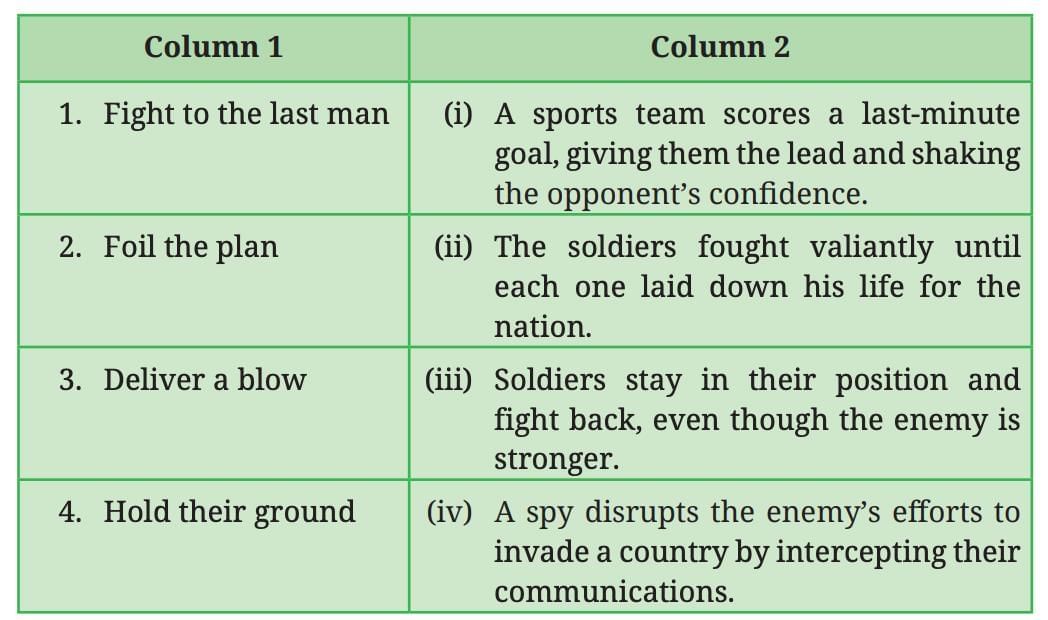
Ans:
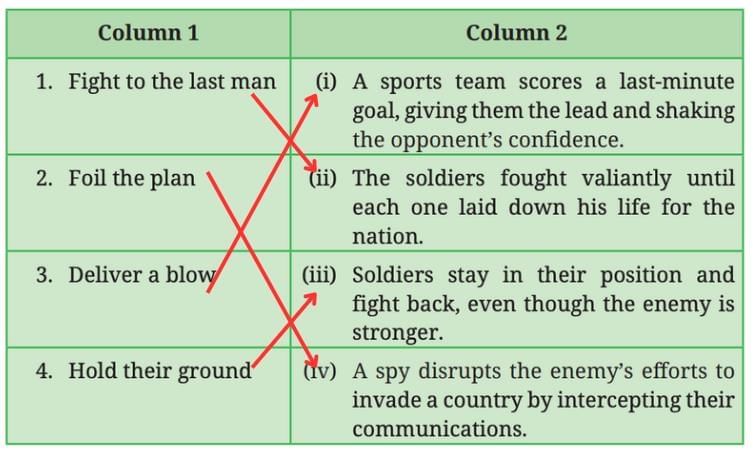
Now, complete the following sentences using the expressions from Column 1.
A. The detective managed to ______________ by finding the hidden evidence before the culprit could get rid of it.
B. The company’s new advertising campaign was meant to ______________ to their competitors’ sales.
C. The hikers chose to ______________ despite the heavy rain, refusing to turn back on their journey.
D. Despite being heavily outnumbered, the soldiers vowed to defend their homeland and ______________, refusing to surrender to the enemy forces.
A. The detective managed to foil the plan by finding the hidden evidence before the culprit could get rid of it.
B. The company’s new advertising campaign was meant to deliver a blow to their competitors’ sales.
C. The hikers chose to hold their ground despite the heavy rain, refusing to turn back on their journey.
D. Despite being heavily outnumbered, the soldiers vowed to defend their homeland and fight to the last man, refusing to surrender to the enemy forces.
II. Read the highlighted words in the following sentence from the text.
A contingent of troops posted to Jammu and Kashmir was air-lifted into Srinagar… There are many such collective nouns used in the context of armed forces.
Match the collective nouns in Column 1 to their meanings in Column 2.
You may refer to a dictionary
A contingent of troops posted to Jammu and Kashmir was air-lifted into Srinagar… There are many such collective nouns used in the context of armed forces.
Match the collective nouns in Column 1 to their meanings in Column 2.
You may refer to a dictionary
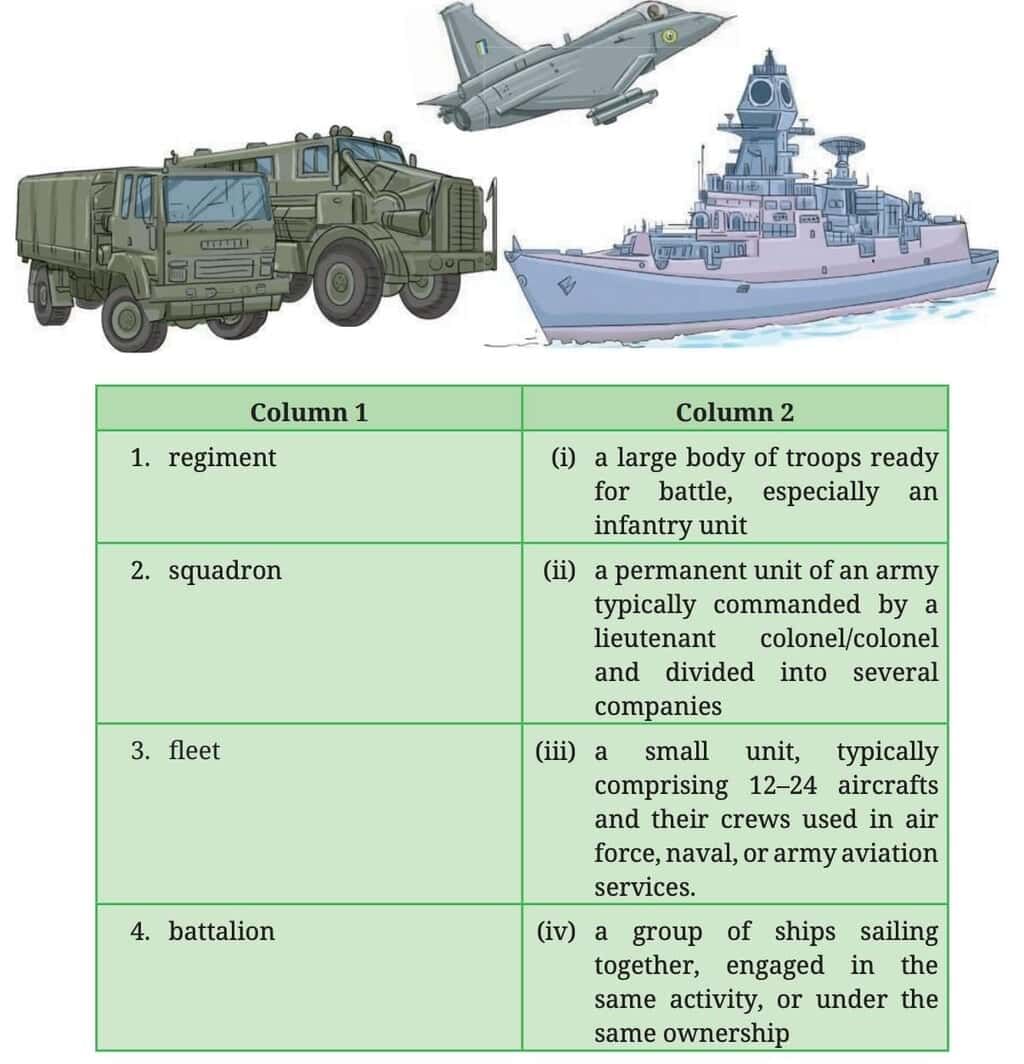
Ans:
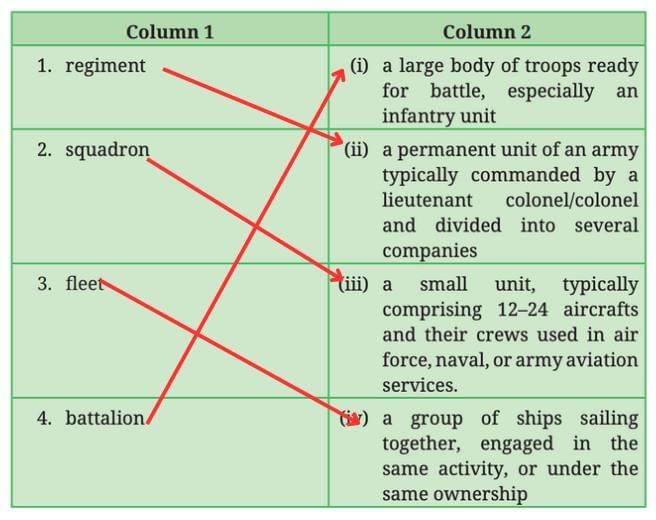
Now, fill in the blanks suitably with words from Column 1 in the table.
A. The commanding officer addressed the entire ________ of soldiers during the morning assembly.
Ans: The commanding officer addressed the entire battalion of soldiers during the morning assembly.
B. The admiral ordered the entire ________ to set sail for battle.
Ans: The admiral ordered the entire fleet to set sail for battle.
C. The ________ of infantry advanced slowly through the dense forest.
Ans: The regiment of infantry advanced slowly through the dense forest.
D. A ________ of fighter jets was sent to intercept the enemy planes.
Ans: A squadron of fighter jets was sent to intercept the enemy planes.
III. Read the following words from the text and fill in the blanks with the correct words by taking clues from the meanings given below in the box. Meanings
1. To take and seize control: ____________
Ans: To take and seize control: overthrow
2. To invade or occupy an area in large numbers: ____________
Ans: To invade or occupy an area in large numbers: overrun
3. To flood or overpower someone or something emotionally:____________
Ans: To flood or overpower someone or something emotionally: overwhelm
Now, create a list of at least five other verbs that begin with ‘over’ and frame sentences of your own.
Ans:
1.Overcome – She managed to overcome her fear of public speaking.
2.Overestimate – Don’t overestimate your ability to complete the project in one day.
3.Overreact – Please don’t overreact to a small mistake.
4. Overcook – He overcooked the pasta, so it turned out too soft.
5. Overlook – I overlooked the spelling error in the report.
IV. In the following pairs of words, ‘c’ is used for nouns, while ‘s’ is used for verbs.
- advice (noun) and advise (verb)
- practice (noun) and practise (verb)
- device (noun) and devise (verb)
- council (noun) and counsel (verb)
Now, fill in the blanks correctly with the words given in the brackets.
1. The teacher’s (i) ____________ is always helpful, and she continues to (ii) ____________ students on their career choices. (advice/advise)
Ans: The teacher’s (i) advice is always helpful, and she continues to (ii) advise students on their career choices.
2. The musician believes that daily (i) ____________ helps a lot, so she is always ready to (ii) ____________ her harmonium lessons. (practice/practise)
Ans: The musician believes that daily (i) practice helps a lot, so she is always ready to (ii) practise her harmonium lessons.
3. The scientist uses a strange (i) ____________ for experiments and plans to (ii) ____________ new methods for his analysis. (device/devise)
Ans: The scientist uses a strange (i) device for experiments and plans to (ii) devise new methods for his analysis.
4. The village (i) ____________ met to discuss issues and decided to(ii) ____________ the villagers on important matters. (council/counsel)
Ans: The village (i) council met to discuss issues and decided to (ii) counsel the villagers on important matters.
V. Read the highlighted words in the following sentences from the text.
- …ended with echoes of courage that serve as an inspiration…
- A contingent of troops posted to Jammu and Kashmir was airlifted into Srinagar…
- D Company with 90 soldiers was the last, and they were expected to return by 2:00 p.m.
- The life and sacrifice of Major Somnath Sharma embody the highest ideals of duty, honour, and patriotism.
The highlighted words are either singular verbs or plural verbs. They are in agreement with the subject of the sentence. This is called Subject-Verb Agreement.
Now, fill in the blanks for the following sentences by choosing the correct verb given within brackets.
1. The bouquet of flowers __________ (is/are) beautiful.
Ans: The bouquet of flowers is beautiful.
2. Neither the teacher nor the students __________ (was/were) aware ofthe change in the schedule.
Ans: Neither the teacher nor the students were aware of the change in the schedule.
3. Each of the participants __________ (has/have) submitted their projectson time.
Ans: Each of the participants has submitted their projects on time.
4. The data collected by the researchers __________ (shows/show)significant trends.
Ans: The data collected by the researchers show significant trends.
5. One of the players __________ (was/were) injured during the match.
Ans: One of the players was injured during the match.
6. Either the children or their guardian __________ (has/have) to attend the meeting.
Ans: Either the children or their guardian has to attend the meeting.
7. A pair of shoes __________ (is/are) missing from the rack.
Ans: A pair of shoes is missing from the rack.
8. Neither of the statements __________ (is/are) true.
Ans: Neither of the statements is true.
9. The members of the jury __________ (has deliver/have delivered) their verdict to the court.
Ans: The members of the jury have delivered their verdict to the court.
10. Mathematics __________ (is/are) an interesting subject for many students.
Ans: Mathematics is an interesting subject for many students.
VI. Read the following passage and correct the incorrect usage of verbs. One example has been done for you.
A battalion of soldiers stand at attention as the National flag are raised.
A battalion of soldiers stands at attention as the National flag is raised.
Each soldier salute with pride while the commander and his assistants inspects the parade. The sound of marching feet echo through the air as a group of cadets prepare for their drill. Meanwhile, a convoy of military vehicles pass by, drawing cheers from the gathered crowd.
A battalion of soldiers stand at attention as the National flag are raised.
A battalion of soldiers stands at attention as the National flag is raised.
Each soldier salute with pride while the commander and his assistants inspects the parade. The sound of marching feet echo through the air as a group of cadets prepare for their drill. Meanwhile, a convoy of military vehicles pass by, drawing cheers from the gathered crowd.
Ans: Each soldier salutes with pride while the commander and his assistants inspect the parade. The sound of marching feet echoes through the air as a group of cadets prepares for their drill. Meanwhile, a convoy of military vehicles passes by, drawing cheers from the gathered crowd.
I. You will listen to a talk about the Param Vir Chakra. As you listen, complete the sentences by filling in the blanks with one or two exact words or phrases you hear. (Transcript for teacher on page 98)
1. The Param Vir Chakra signifies the ‘Wheel of the Ultimate ____________’.
1. The Param Vir Chakra signifies the ‘Wheel of the Ultimate ____________’.
Ans: The Param Vir Chakra signifies the ‘Wheel of the Ultimate Brave’.
2. The Param Vir Chakra is awarded to someone who shows exemplary bravery while fighting with the ____________.
Ans: The Param Vir Chakra is awarded to someone who shows exemplary bravery while fighting with the enemy.
3. The Param Vir Chakra was introduced as a Gallantry Medal in 1947by the ____________.
Ans: The Param Vir Chakra was introduced as a Gallantry Medal in 1947 by the President of India.
4. The design of the Param Vir Chakra is inspired by Sage Dadhichi, who was a ____________.
Ans: The design of the Param Vir Chakra is inspired by Sage Dadhichi, who was a Vedic rishi.
5. The state emblem in the centre of the Param Vir Chakra is surrounded by the Vajra and ____________.
Ans: The state emblem in the centre of the Param Vir Chakra is surrounded by the Vajra and lotus flowers.
Ans: The state emblem in the centre of the Param Vir Chakra is surrounded by the Vajra and lotus flowers.
I. As the citizens of a nation, we all must fulfil our duty. In groups of 4–5, speak about how you propose to serve your nation.You can choose from the themes given below:
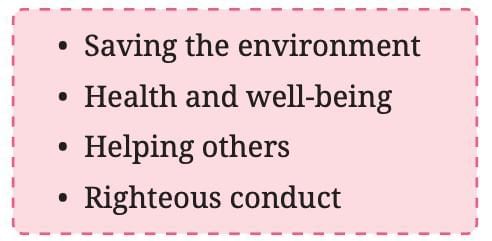
You may use the sentence prompts given below to organise what you speak about.
• I believe one of the best ways to serve the nation is by...
• A small change we can make is... and it will have a big impact because...
• If everyone contributes by... it can lead to...
• One of the biggest challenges we face is... and I propose we address it by...
• We can make a difference by working together as a team, if we...
• Serving the nation is not just about big actions; even small efforts like...matter.
You may use the sentence prompts given below to organise what you speak about.
• I believe one of the best ways to serve the nation is by...
• A small change we can make is... and it will have a big impact because...
• If everyone contributes by... it can lead to...
• One of the biggest challenges we face is... and I propose we address it by...
• We can make a difference by working together as a team, if we...
• Serving the nation is not just about big actions; even small efforts like...matter.
Ans: This is a classroom activity. In groups of 4-5, discuss how to serve the nation using these prompts:Example: I believe one of the best ways to serve the nation is by saving the environment. A small change we can make is planting trees, and it will have a big impact because it keeps the air clean. If everyone contributes by recycling, it can lead to a healthier planet. One of the biggest challenges we face is pollution, and I propose we address it by using less plastic.
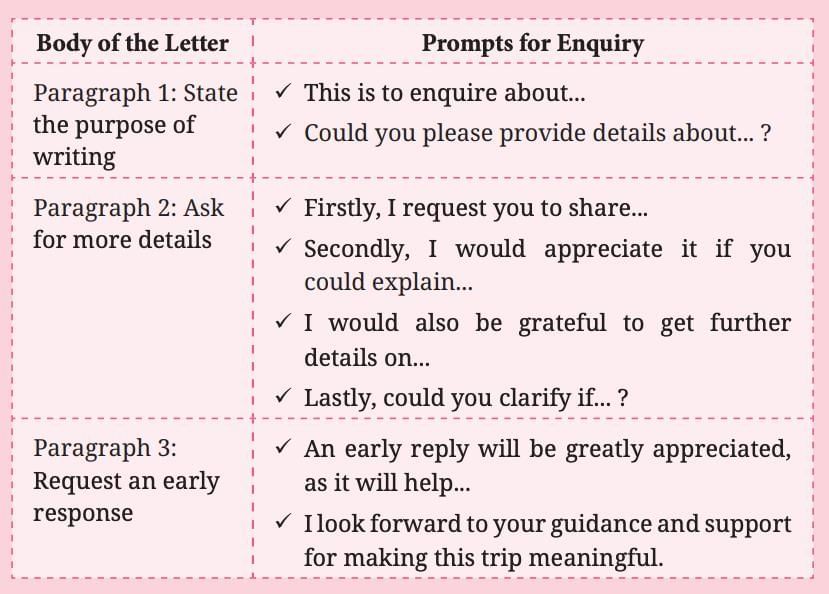
I. A letter of enquiry is a formal letter written to seek detailed information about something the writer wants to know. For example, it can be used for joining a course, organising an event, knowing details about a trip, etc. The language used is formal and specific, with relevant queries. Now, write a letter of enquiry. Your school wishes to organise a visit to a Memorial in your state/region. Write the letter to the person in charge of that memorial, requesting information regarding available dates for visits, the duration of the tour, any entry fees, and guidelines for student groups.
• Follow the given layout.
• Use the cues given below to draft the letter.
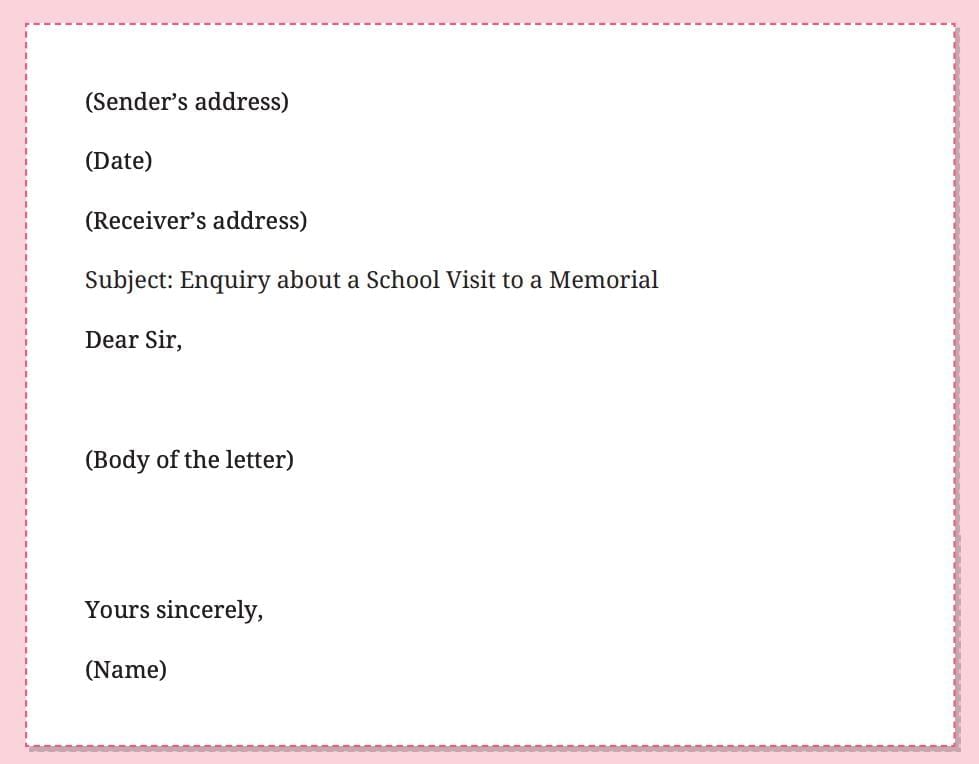
• Follow the given layout.
• Use the cues given below to draft the letter.
Ans:Your Address
[City, State, ZIP Code]
31 July 2025The In charge
National War Memorial
[City, State]Subject: Enquiry about a School Visit to the National War Memorial
Dear Sir/Madam,
This is to enquire about organizing a school visit to the National War Memorial for our students. Could you please provide details about available dates for visits? Secondly, I would appreciate it if you could explain the duration of the tour and any entry fees. Lastly, could you clarify if there are specific guidelines for student groups? An early reply will be greatly appreciated, as it will help us plan a meaningful trip.
Yours sincerely,
[Your Name]
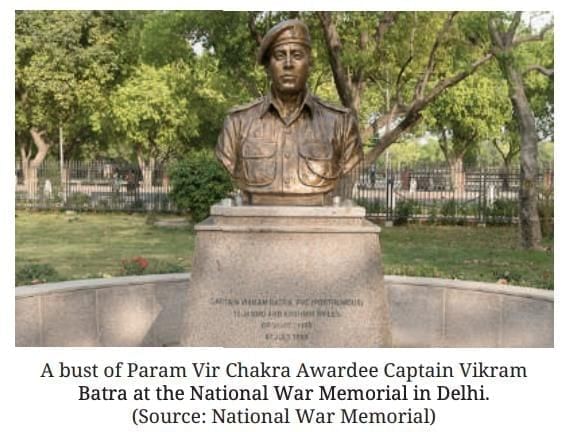
I. Out of twenty-one PVC awardees, Major Somnath Sharma was the first recipient of the PVC, and Captain Vikram Batra was the last recipient of the PVC, the highest gallantry award. Captain Vikram Batra is popularly remembered as the “Shershah of Kargil”. His iconic success signal was‘Yeh Dil Mange More’. Captain Vikram Batra, the D Company commander, was tasked to capture Point 5140 on 20 June 1999, which he did with exemplary courage. After Point 5140 was captured, 13 JAK RIF was tasked to capture Point 4875. On 07 July 1999, Captain Batra led the assault from the front and engaged in a physical fight with the enemy. He killed five enemy soldiers at point-blank range and sustained serious injuries himself. Despite his injuries, his dauntless determination inspired his men to clear the enemy from a dominating position. Later, he succumbed to his injuries. His fearless determination and leadership encouraged his company men to avenge his death and finally capture Point 4875. His inspiring leadership, dedication to duty, and steadfast love for his country continue to be an inspiration for the younger generation. He attended the call of duty with absolute disregard for his safety. He was awarded the Param Vir Chakra (Posthumously).
II. Gallantry awards in India are given to military personnel and others for displaying extraordinary courage in the line of duty. Some of the gallantry awards in India are:
• Param Vir Chakra: The highest military award in India, awarded for the most conspicuous bravery in the presence of the enemy.
• Maha Vir Chakra: The second-highest military award in India, awarded for acts of gallantry in the presence of the enemy.
• Vir Chakra: Awarded for acts of gallantry in the presence of the enemy.
Find out more about gallantry awards.
II. Gallantry awards in India are given to military personnel and others for displaying extraordinary courage in the line of duty. Some of the gallantry awards in India are:
• Param Vir Chakra: The highest military award in India, awarded for the most conspicuous bravery in the presence of the enemy.
• Maha Vir Chakra: The second-highest military award in India, awarded for acts of gallantry in the presence of the enemy.
• Vir Chakra: Awarded for acts of gallantry in the presence of the enemy.
Find out more about gallantry awards.
Ans: Gallantry awards in India include:
- Param Vir Chakra: The Highest award for bravery against the enemy, like Major Somnath Sharma received.
- Maha Vir Chakra: Second-highest award for gallantry in battle.
- Vir Chakra: Given for courageous acts against the enemy.
III. The Indian government has been steadfast in its initiatives to boost the representation of women in the Indian Armed Forces. These women have been serving the nation selflessly and with pride. Find out the key roles of women in the Indian Army. Share the information with your classmates and teacher.
Ans: Women in the Indian Army serve as officers, doctors, nurses, engineers, and in logistics. They also work in communication, intelligence, and training roles, contributing bravely to the nation’s defence.
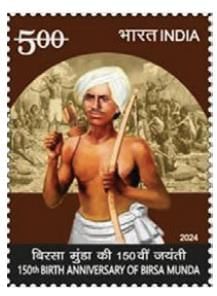
IV. Birsa Munda: A Saga of Courage and Sacrifice Birsa Munda, a revered tribal freedom fighter, spiritual leader, and folk hero, belonged to the Munda tribe. Celebrated as an avenging warrior and a charismatic figure, he emerged as a powerful symbol of tribal resistance against British colonial rule. Among the people of Jharkhand, he is affectionately known as Dharti Aaba—Father of the Land—and is honoured as a divine figure for his selfless dedication to his people. A commemorative stamp designed by Shri Sankha Samanta captures his powerful presence. It features Birsa Munda addressing his followers with a determined expression that reflects his unwavering vision of tribal unity, empowerment, and self-governance. This stamp serves as a lasting tribute to his pivotal role in India’s freedom struggle and his relentless commitment to protecting tribal rights.
V. Make a list of the patriotic songs in any language, including songs from your region. Share the songs with your classmates and teacher.
Ans: Examples of patriotic songs:
1. Vande Mataram
2. Jana Gana Mana
3. Ae Mere Watan Ke Logon
4. Mera Rang De Basanti Chola
5. Sare Jahan Se Achha
NCERT Class 8 Eglish Poorvi - UNIT -1 Chapter 3 Wisdom Paves the way
NCERT Class 8 Eglish Poorvi - UNIT -1 Chapter 3 Wisdom Paves the way
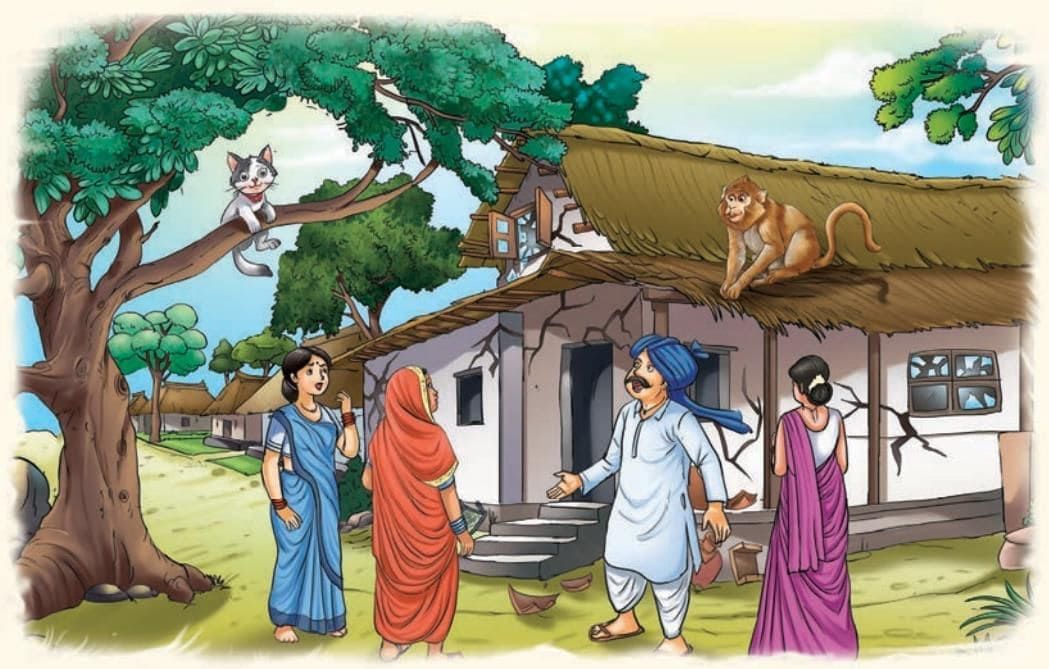
Q3: Observe the picture. What do you think might have happened? Share your answers with your classmates and teacher.Q1:
Q1: Why do we seek the advice of the elderly in our family?
Ans: We seek advice from the elderly in our family because they have more experience and wisdom, which helps us make good decisions.
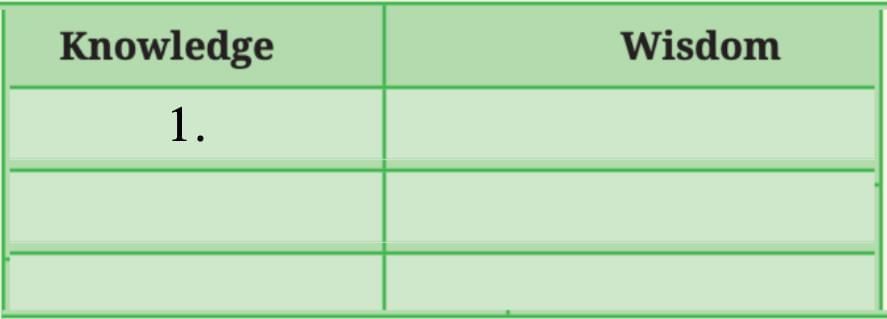
Q2: Knowledge is about learning facts and information, while wisdom is about using that knowledge with good judgment.
Work in pairs. Read the following situations and classify each one as either ‘knowledge’ or ‘wisdom’. One example has been done for you. 1. Riya’s understanding of plant care helped her grow a healthy vegetable garden in her backyard.
2. Mr. Kumar values time with family over chasing wealth.
3. Karuna’s expertise in computer programming helped her develop a successful app.
4. Rohan understood the value of time management and created a timetable to complete his assignments systematically.
5. Ramesh chose to forgive his friend for a misunderstanding.
6. Ms. Vaijayanthi delivered a lecture on Indian Classical music at the cultural festival.
Work in pairs. Read the following situations and classify each one as either ‘knowledge’ or ‘wisdom’. One example has been done for you. 1. Riya’s understanding of plant care helped her grow a healthy vegetable garden in her backyard.
2. Mr. Kumar values time with family over chasing wealth.
3. Karuna’s expertise in computer programming helped her develop a successful app.
4. Rohan understood the value of time management and created a timetable to complete his assignments systematically.
5. Ramesh chose to forgive his friend for a misunderstanding.
6. Ms. Vaijayanthi delivered a lecture on Indian Classical music at the cultural festival.
Ans:
Q3: Observe the picture. What do you think might have happened? Share your answers with your classmates and teacher.
Ans: Example Response:
In the picture, it seems that a strong earthquake or storm has recently affected the village. The house shown is badly damaged, with big cracks on the walls and a broken roof. Pieces of the roof are lying on the ground. A monkey is sitting on the roof and a cat is sitting on a tree, which shows that even animals are disturbed and scared. Four people are standing outside the house, talking to each other, probably discussing what has happened and what to do next. The scene shows worry and confusion among the villagers. It clearly looks like a natural disaster has caused the damage.
I. Complete the following sentences with suitable reasons. One example has been done for you. Share your answers with your classmates and teacher.
1. Shiv Datt said, “I believe it has been over a week, perhaps even longer,” because it had been a long time since they left the village.
Ans: it had been a long time since they left the village.
2. Dev Datt said, “Indeed, we ought to be united in this hope. That is whywe press on towards Ujjain,” because ___________________________.
Ans: he believed they should stay hopeful together to find work with the King.
3. Har Datt said, “Look there, friends. A camel has passed this way. Thetracks are fresh,” because ___________________________.
Ans: he saw fresh camel tracks on the road, showing a camel had recently passed.
4. Shiv Datt said, “It appears to be a merchant, running as if pursued by trouble,” because ___________________________.
Ans: the merchant was rushing towards them, looking worried, as if something was wrong.
5. The merchant said, “How could you possibly know that? The poorcreature has been unwell for two weeks now. Surely you are a healer!” because ___________________________.
Ans: the young men described the camel’s exact condition, making him think they had special knowledge.
6. Dev Datt said, “You are free to do as you wish, sir. If the King desiresour presence, we shall be waiting under that banyan tree yonder,” because ___________________________.
Ans: he was confident they had done nothing wrong and were willing to face the King.
I. Arrange the following events in order of their occurrence from Scene II of the play. One example has been done for you. Share your answers with your classmates and teacher.
1. The King makes the four young men his advisers, impressed by their skills. (8)
1. The King makes the four young men his advisers, impressed by their skills. (8)
2. Ram Datt explains how he infers from the tracks that the camel is lame.
3. The King asks the merchant to clearly state his accusation.
4. The King praises the young men for their observations and dismisses the merchant’s accusation.
5. Shiv Datt reveals that the camel is blind in its right eye, as it had only chewed on the leaves on the left side of the road.
6. Dev Datt explains his observation about the camel’s pain and careful movement.
7. Har Datt clarifies how he knew that the camel had a short tail.
8. The merchant accuses the four men of knowing a lot about his missing camel.
Ans:
(3) The King asks the merchant to clearly state his accusation.
(8) The merchant accuses the four men of knowing a lot about his missing camel.
(2) Ram Datt explains how he infers from the tracks that the camel is lame.
(5) Shiv Datt reveals that the camel is blind in its right eye as it had only chewed on the leaves on the left side of the road.
(7) Har Datt clarifies how he knew that the camel has a short tail.
(6) Dev Datt explains his observation about the camel’s pain and careful movement.
(4) The King praises the young men for their observations and dismisses the merchant’s accusation.
(1) The King makes the four young men his advisers, impressed by their skills.
I. Read the given extracts and answer the questions that follow.
Q1: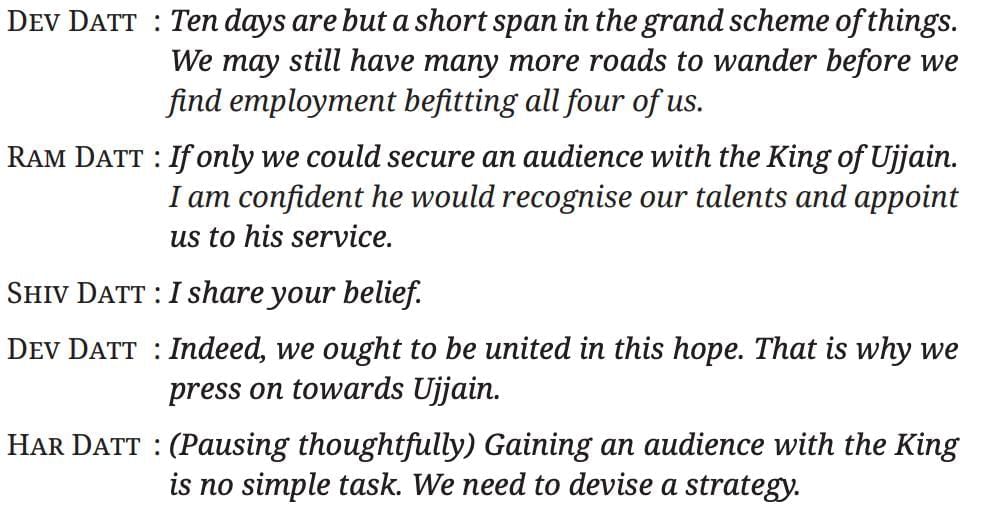
(i) Identify the false statement and rectify it.
A. Dev Datt believes that finding employment is an easy task
Ans: False
Rectified: Dev Datt believes that finding employment is a challenging task that may take time.
B. Ram Datt is confident that the King would recognise their talents
Ans: True
(ii) What does Ram Datt’s confidence in gaining the King’s recognition tell us about him?
Ans: Ram Datt’s confidence shows he is optimistic and believes strongly in his and his friends’ abilities.
(iii) Complete the sentence given below with the correct option from those given. In the line, ‘That’s why we press on towards Ujjain’, the phrase ‘press on’ refers to __________.
A. walking with heavy steps
B. moving forward with determination
C. Slowing down frequently for rest
D. stopping briefly to save time
Ans: In the line, “That’s why we press on towards Ujjain,” the phrase ‘press on’ refers to: B. moving forward with determination
(iv) Har Datt says, “We need to devise a strategy.” What can be inferred about Har Datt’s character from his statement?
A. He is doubtful of their abilities and wants to give up.
B. He is eager to rush into the palace without preparation.
C. He is cautious and thoughtful, preferring to plan ahead.
D. He relies on others to make decisions for the group.
A. He is doubtful of their abilities and wants to give up.
B. He is eager to rush into the palace without preparation.
C. He is cautious and thoughtful, preferring to plan ahead.
D. He relies on others to make decisions for the group.
Ans: C. He is cautious and thoughtful, preferring to plan ahead.
Q2: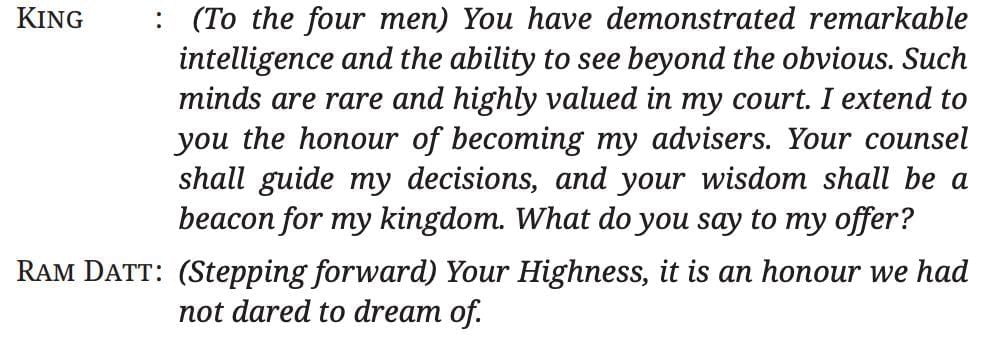
(i) Select the option that is true for both Assertion (A) and Reason (R).
(A): The Merchant left the court feeling humbled and ashamed.
(R): The King commanded that the four wise men join his court.
A. Both (A) and (R) are true, and (R) is the correct explanation of (A).
B. Both (A) and (R) are true, but (R) is not the correct explanation of (A).
C. (A) is true, but (R) is false.
D. (A) is false, but (R) is true
Ans: B. Both (A) and (R) are true, but (R) is not the correct explanation of (A).
(ii) Complete the following sentence by choosing the correct option. The line, ‘See beyond the obvious’ means that the men had the ability to ______.
A. Challenge common beliefs with reasoning
B. interpret information in traditional ways
C. Notice details that others might overlook
D. Predict what is going to happen in the future
A. Challenge common beliefs with reasoning
B. interpret information in traditional ways
C. Notice details that others might overlook
D. Predict what is going to happen in the future
Ans: C. Notice details that others might overlook
(iii) Complete the following sentence with a suitable reason.
Ram Datt described the King’s offer as ‘an honour we had notdared to dream of’ because ___________.
Ram Datt described the King’s offer as ‘an honour we had notdared to dream of’ because ___________.
Ans: Ram Datt described the King’s offer as “an honour we had not dared to dream of” because it was a great and unexpected opportunity to serve as the King’s advisers.
(iv) How does the King’s offer to the four men reflect his values asa ruler?
Ans: The King’s offer shows he values wisdom, intelligence, and fairness, as he rewards the men for their clever observations and trusts them to guide his kingdom.
II. Answer the following questions
Q1: What does the dusty road leading to Ujjain tell us about the challenges of the young men’s journey?
Ans: The dusty road shows the journey was long, tiring, and difficult, as they walked for ten days under the hot sun, facing physical hardship.
Q2: Why did the merchant become suspicious of the four men? What does this tell us about him?
Ans: The merchant became suspicious because the men knew specific details about his camel without seeing it. This shows he is quick to judge and distrustful.
Q3: How do the four young men’s observations about the camel serve as a turning point in the play?
Ans: Their observations prove their intelligence to the King, turning the accusation against them into an opportunity to become his advisers.
Q4: Why did the King believe the four young men and not the merchant?
Ans: The King believed the men because they explained their observations logically, showing wisdom, while the merchant’s accusations lacked proof.
Q5: How does the capability of the four young men make them suitable to become advisors?
Ans: Their ability to notice details, think logically, and explain their observations makes them suitable to give wise advice to the King.
Q6: Why does the merchant feel ashamed for accusing the four young men of stealing his camel?
Ans: The merchant feels ashamed because the King proved the men were innocent and wise, showing his accusations were wrong and unfair.
I. Complete the sentences by filling in the noun form of the textual words given in the brackets.
1. Some word games need a lot of thought and _________________. (deduce)
Ans: deduction
2. We need to make close _________________of animals in order to understand their behaviour. (observe)
Ans: observations
3. A detailed _________________ of the documents shows a lot of errors. (scrutinise)
Ans: scrutiny
4. You should not make any false ________________ against anyone. (accuse)
Ans: accusations
5. She was given an award in _________________of her contribution to literature. (recognise)
Ans: recognition
II. Match the expressions in Column 1 with their meanings in Column 2
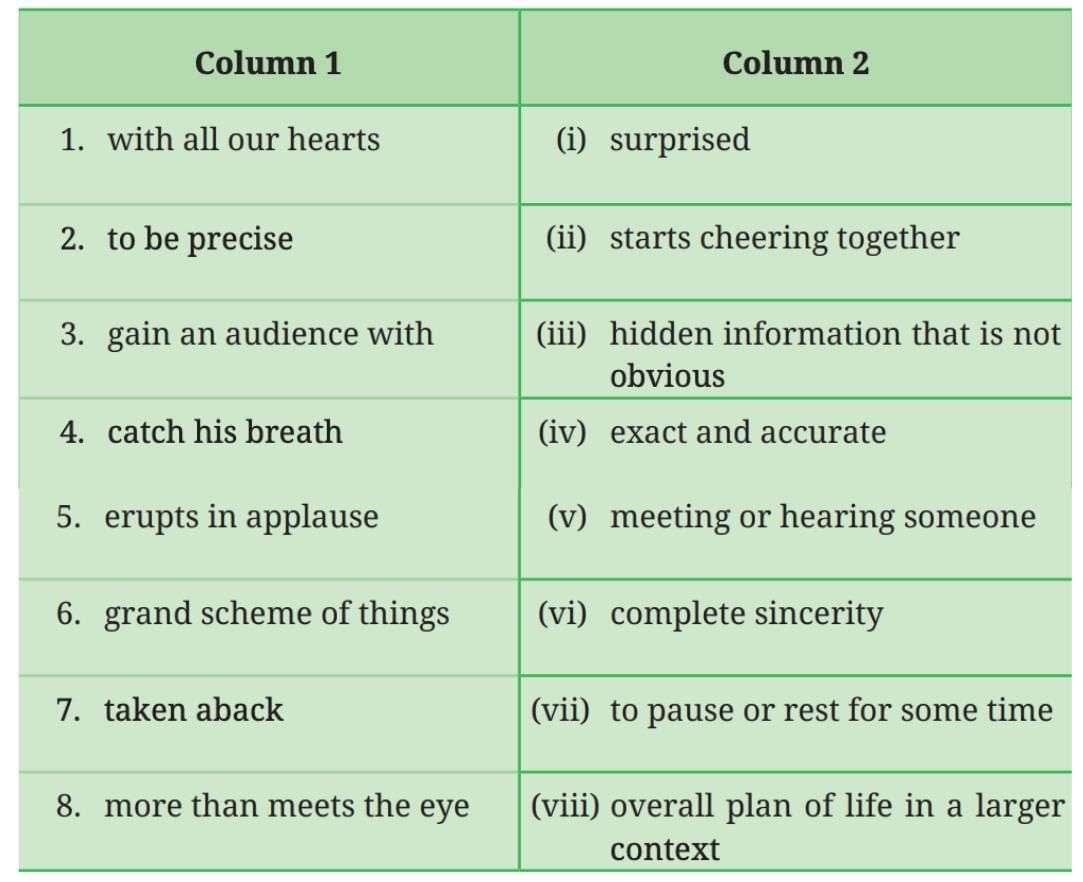
Ans:
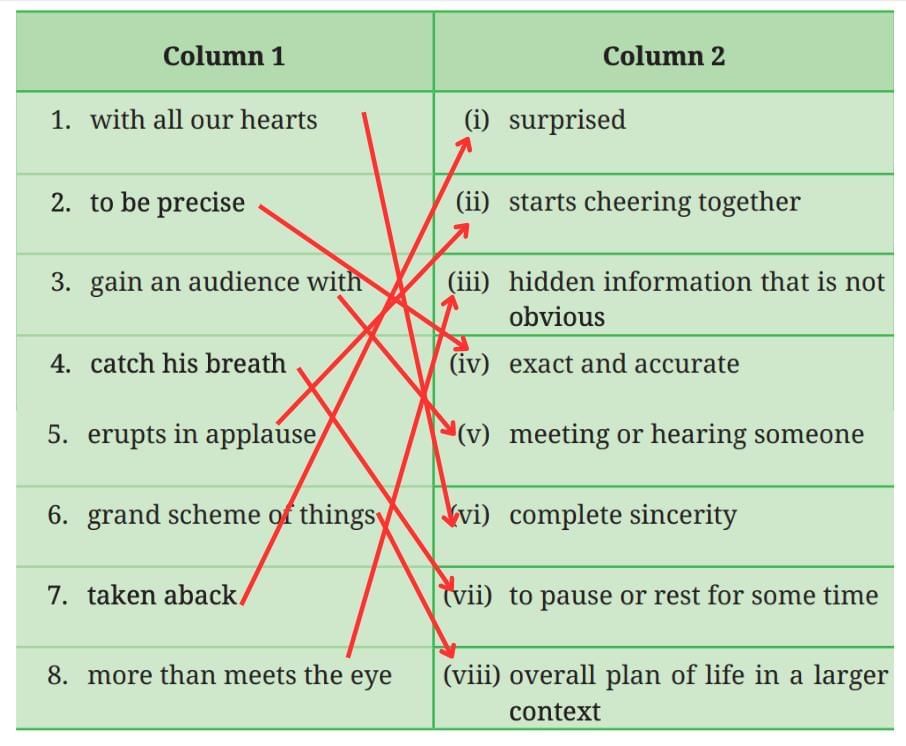
Now, make sentences using any five of the expressions from Column 1
1. With all our hearts, we thanked the doctor for saving our brother’s life.
2. To be precise, the meeting starts at 10:15 a.m., not 10 o’clock.
3. She was finally able to gain an audience with the principal to discuss her concerns.
4. After running up the stairs, he stopped to catch his breath before speaking.
5. The crowd erupted in applause when the singer walked onto the stage.
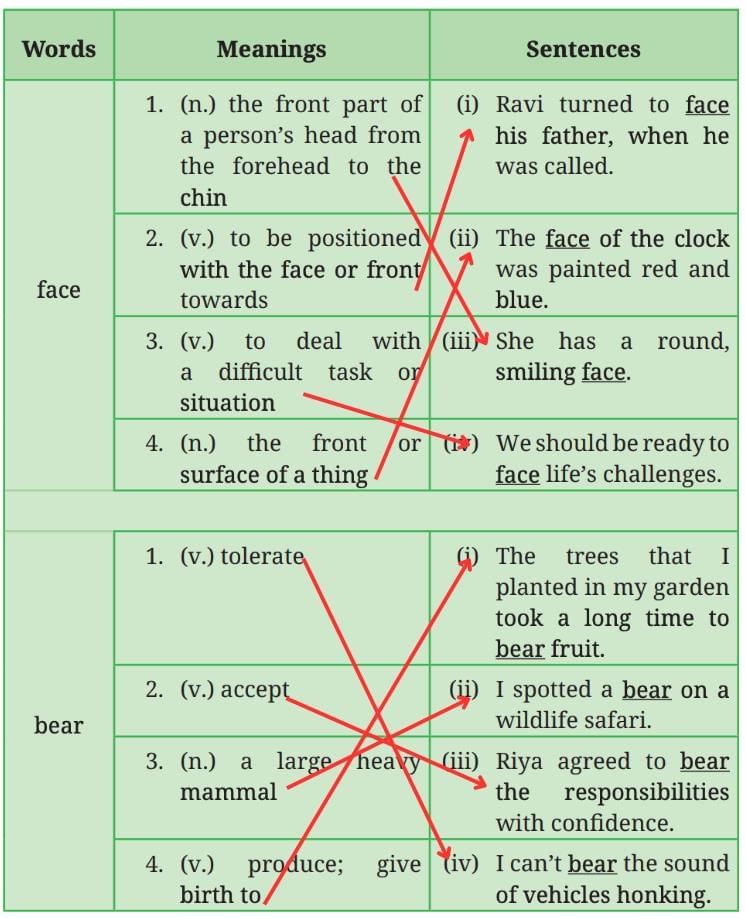
III. Match the different meanings of ‘face’ and ‘bear’ with the correct usage in the sentences given in the table below.
(n. stands for the word noun and v. stands for the word verb.)
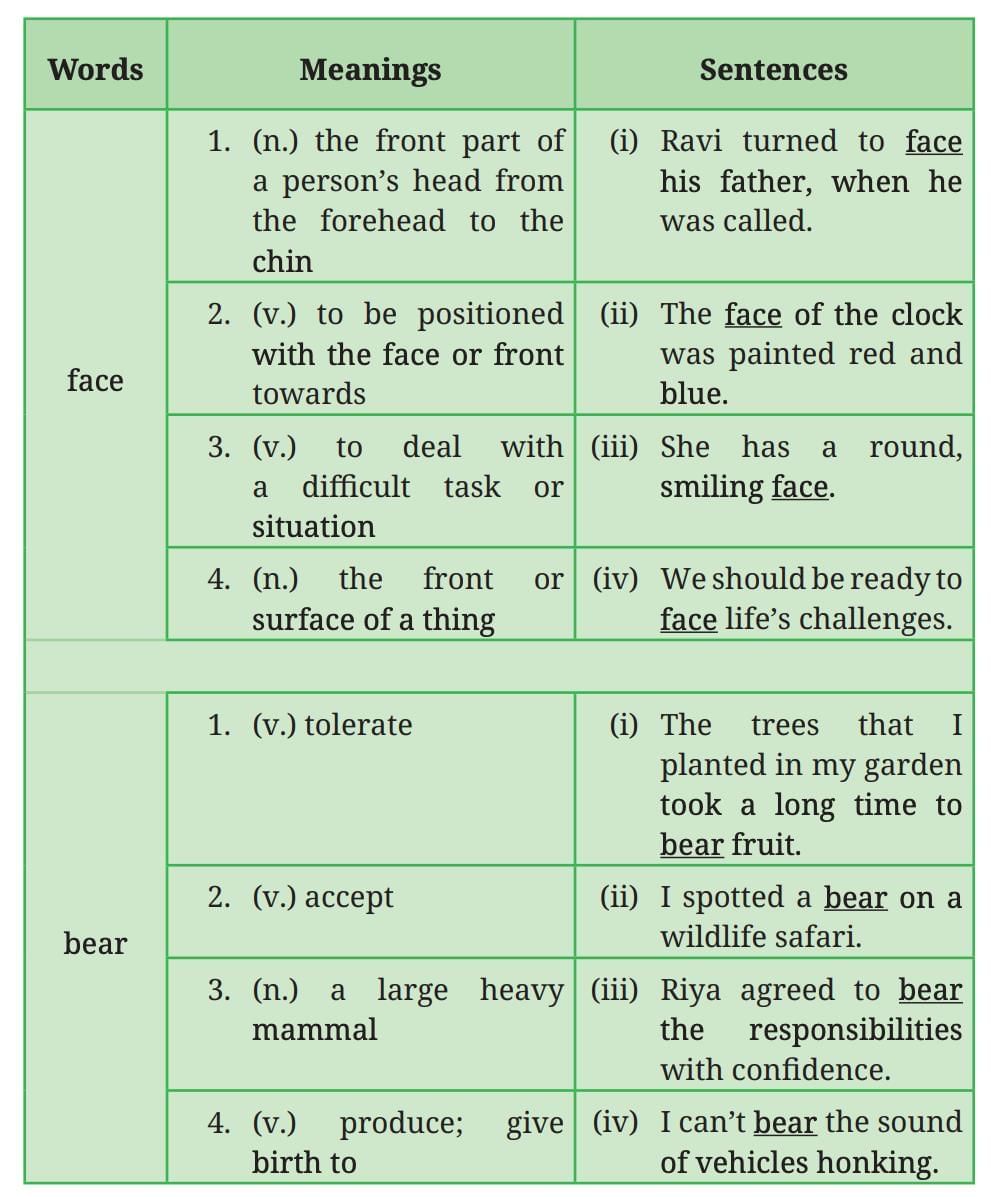
Ans:
IV. Match the highlighted words in the sentences in Column 1 with the functions they express in Column 2.
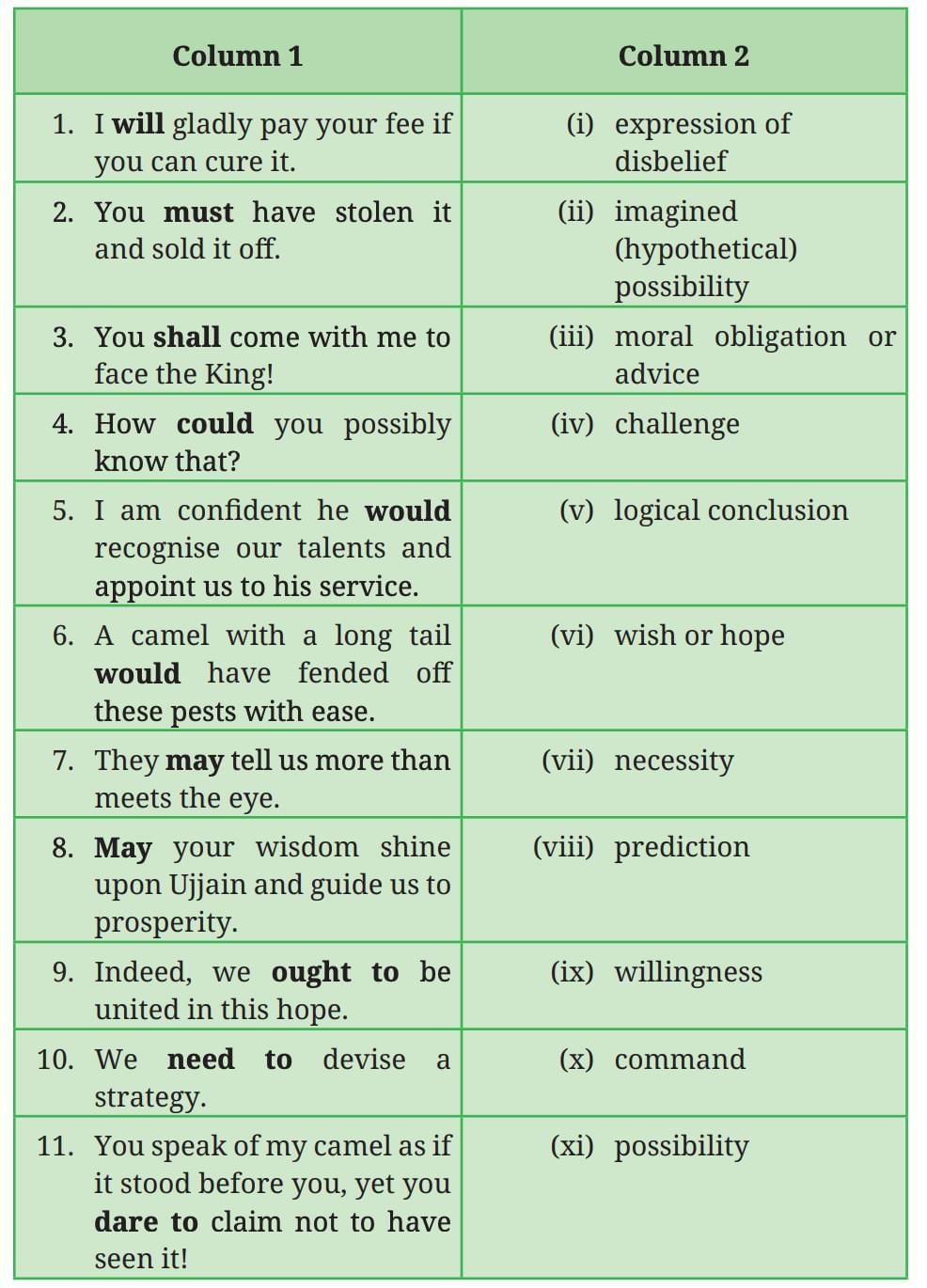
Ans:
1 – ix
2 – v
3 – x
4 – i
5 – viii
6 – ii
7 – xi
8 – vi
9 – iii
10 – vii
11 – iv
V. Complete the following story with modal verbs in the box given belowby using the clues from the functions given within brackets.
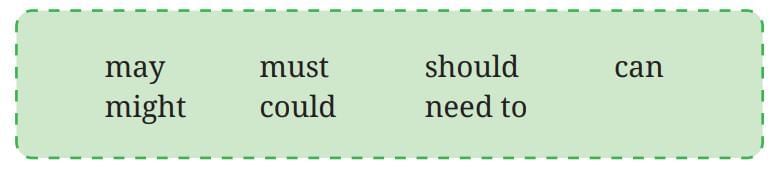 An old man, known for his wisdom, lived in a small village. One day, a young boy asked him, “How 1. _______ (ability) I become wise like you?” The old man smiled and said, “Wisdom 2._______ (necessity) be earned through patience. You 3. _______ (suggestion) listen, more than you speak.” The boy thought for a while and replied, “It 4. _______ (weak possibility) take years, but I’ll try.” The old man nodded. “You 5._______(obligation) learn from your mistakes too. Wisdom 6. _______ (possibility)come slowly, but it always arrives for those who seek it.” The boy knew he 7. _______ (ability) become wise if he followed the old man’s advice.
Ans:
- can
- must
- should
- might
- ought to
- may
- could
VI. Rewrite the following sentences using appropriate modal verbs. You may take clues from the highlighted words.
1. It is advisable for you to think before you speak.
Ans: You should think before you speak.
2. It is unnecessary to worry about things beyond your control.
Ans: You need not worry about things beyond your control.
3. It is not possible for a person to gain experience without taking risks.
Ans: A person cannot gain experience without taking risks.
4. It is essential to treat others with kindness, even when they disagree with you.
Ans: You must treat others with kindness, even when they disagree with you.
5. It is not allowed to interrupt when someone else is speaking.
Ans: You must not interrupt when someone else is speaking.
I. You will listen to four people sharing their thoughts on why they enjoy witty characters in stories. As you listen, match statements 1–6 given below to the speakers (i)–(iv). There are two statements you do not need.
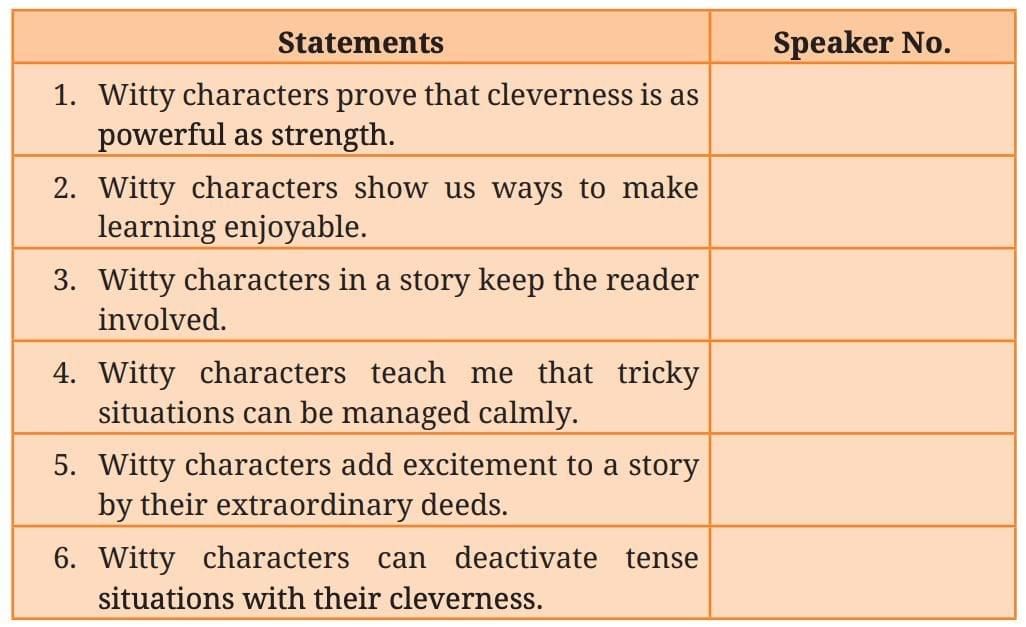
Ans:
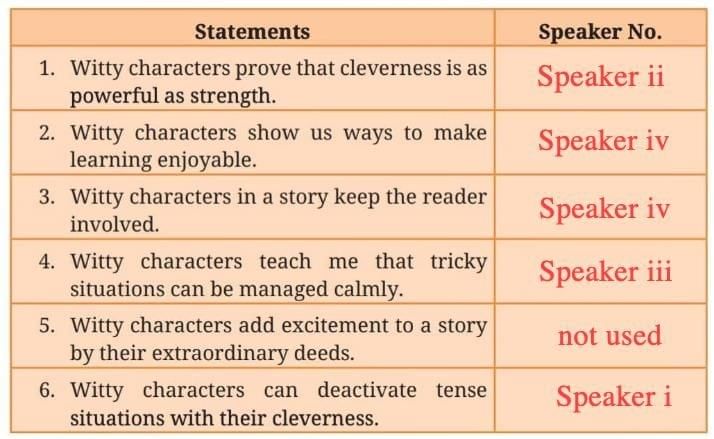
I. The way in which a word is stressed in a sentence can change its meaning. Read the following examples.
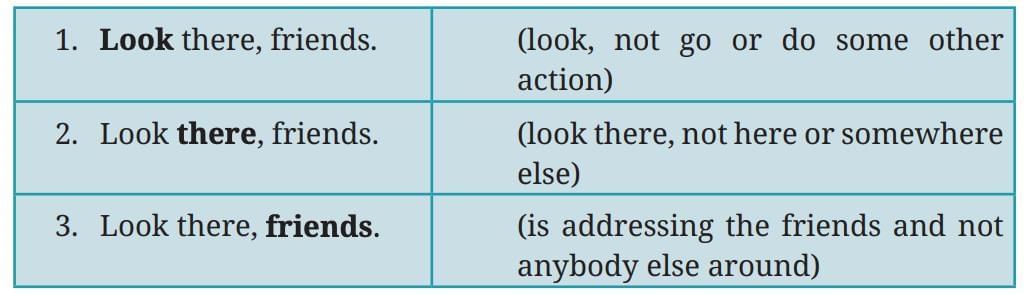
Now, work in pairs. Take turns to say the following sentences aloud by stressing on the highlighted words. Share the meanings of the sentences with each other and teacher.
- I take my dog for a walk in the evening.
- I take my dog for a walk in the evening.
- I take my dog for a walk in the evening.
- I take mydog for a walk in the evening.
- I take my dog for awalk in the evening.
- I take my dog for a walk in the evening.
Ans: This is a classroom activity. Practice saying the following sentences with stress on the highlighted words:
- I take my dog for a walk in the evening. (I, not someone else)
- I take my dog for a walk in the evening. (Take, not another action)
- I take my dog for a walk in the evening. (My dog, not another’s)
- I take my dog for a walk in the evening. (Dog, not another pet)
- I take my dog for awalk in the evening. (Walk, not another activity)
- I take my dog for a walk in theevening. (Evening, not another time)
II. Statements and exclamatory sentences usually end with a falling tone. Listen to the teacher read these sentences aloud and repeat it with the correct intonation.
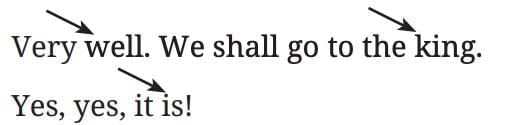
Now, practise by saying the following sentences with the correct intonation.
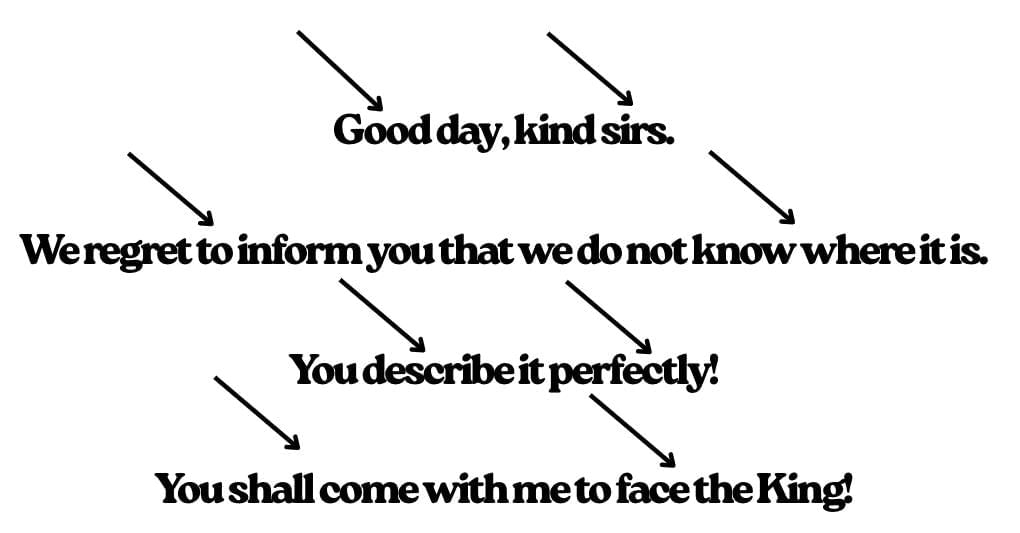
- Good day, kind sirs.
- We regret to inform you that we do not know where it is.
- You describe it perfectly!
- You shall come with me to face the King!
Ans: This is a classroom activity. Practice saying the following sentences with a falling tone:
I. You have observed that the kutcha road leading to your colony is in a very bad condition due to heavy rains. The potholes are dangerous for people and can lead to accidents. They also serve as a breeding ground for mosquitoes, as there is stagnant water all around. Write a letter of complaint to the Commissioner, Municipal Corporation or the Sarpanch, Gram Panchayat to look into the matter and take necessary action. Follow the format of a formal letter and draft the letter with the help of the cues given below.
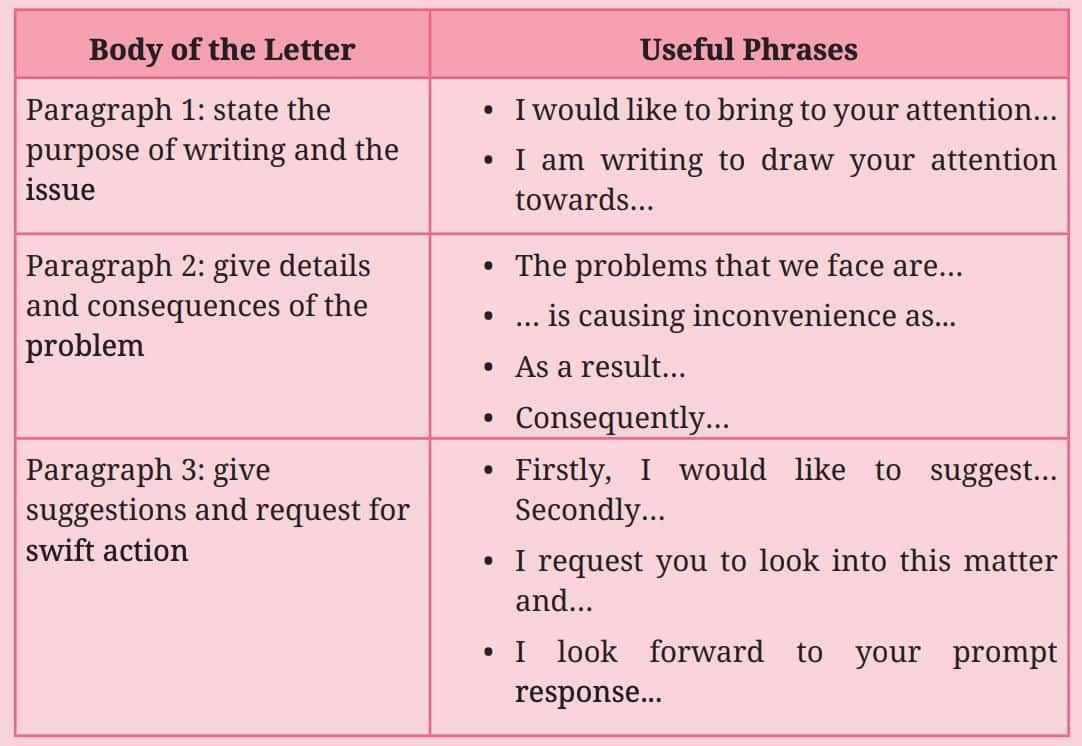
Ans: Example Response:
To
The Commissioner,
Municipal Corporation,
[City Name]Date: 31 July 2025
Subject: Complaint regarding the poor condition of the kutcha road leading to our colony
Respected Sir/Madam,
I would like to bring to your attention the poor condition of the kutcha road leading to our colony. I am writing to draw your attention towards the serious inconvenience being caused to the residents due to the heavy rains.
The problems that we face are many. The road is full of potholes and is almost impossible to walk or drive on safely. It is causing inconvenience as people, especially school children and the elderly, are at risk of falling and getting injured. As a result, several minor accidents have already occurred. Consequently, the stagnant rainwater collected in the potholes has become a breeding ground for mosquitoes, increasing the risk of diseases like dengue and malaria.
Firstly, I would like to suggest that the road be repaired and properly drained at the earliest. Secondly, proper levelling and paving must be ensured to avoid future damage. I request you to look into this matter urgently and take swift action for the safety and well-being of the residents.
I look forward to your prompt response.Thanking you.
Yours sincerely,
Rahul Mehta
Rajiv Nagar Colony
Contact: **********
I. Staging a play requires creativity, organisation, and teamwork. Steps involved in staging a play:
1. Choose a play that suits your requirement of theme, duration, number of actors, and available resources.
2. Choose a director, a stage manager, a light and sound in charge,a props manager, a costume designer, and a makeup artist.
3. Hold auditions and decide the roles.
4. Read the script and plan stage movements and positions for each scene.
5. Make a schedule for rehearsal.
6. Work on the set design (backdrop) and make or collect the required props.
7. Design or gather appropriate costumes.
8. Plan makeup and hairstyles to suit the play’s time period.
9. Check light and sound arrangements.
10. Hold a dress rehearsal including sound and light effects.
11. Promote the event through posters and pamphlets.
12. Organise the backstage with labelled props, costumes, and entrances or exits.
13. Present the play to the audience.
Now, present the enactment of the play ‘Wisdom Paves the Way’ with the help of the steps you have just read. Ensure you use the correct intonation and sentence stress.
II. Stories related to wit and wisdom have always fascinated the readers. Go to the library and read the stories associated with the following.
Vikramaditya and Betal
Tenali Rama
Gopal the Jester
Panchatantra Tales
1. Choose a play that suits your requirement of theme, duration, number of actors, and available resources.
2. Choose a director, a stage manager, a light and sound in charge,a props manager, a costume designer, and a makeup artist.
3. Hold auditions and decide the roles.
4. Read the script and plan stage movements and positions for each scene.
5. Make a schedule for rehearsal.
6. Work on the set design (backdrop) and make or collect the required props.
7. Design or gather appropriate costumes.
8. Plan makeup and hairstyles to suit the play’s time period.
9. Check light and sound arrangements.
10. Hold a dress rehearsal including sound and light effects.
11. Promote the event through posters and pamphlets.
12. Organise the backstage with labelled props, costumes, and entrances or exits.
13. Present the play to the audience.
Now, present the enactment of the play ‘Wisdom Paves the Way’ with the help of the steps you have just read. Ensure you use the correct intonation and sentence stress.
II. Stories related to wit and wisdom have always fascinated the readers. Go to the library and read the stories associated with the following.
Vikramaditya and Betal
Tenali Rama
Gopal the Jester
Panchatantra Tales
NCERT Class 8 Eglish Poorvi - UNIT -1 Chapter 2 A Concrete Example
NCERT Class 8 Eglish Poorvi - UNIT -1 Chapter 2 A Concrete Example
I) Read the names of items you usually find in a garden and write their names against each picture given below.
garden hoşe, sapling, hedge, flower beds, flower pot, pebbles, rockery, fence, vine, wheelbarrow
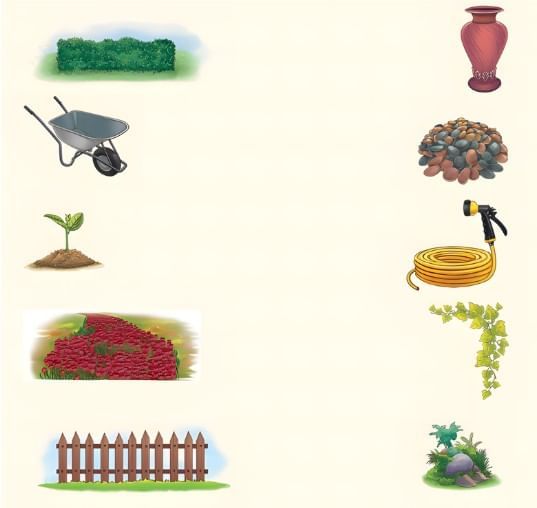
Ans: 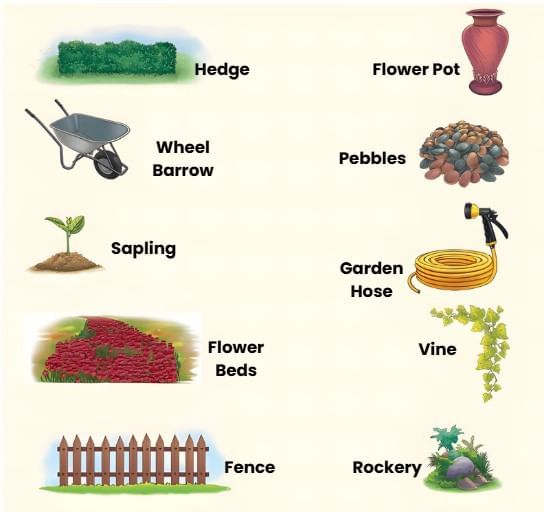
II) Work in groups of four. What kind of garden would you like to have? Mention the features that you can include and the reasons for your choice. Share your answers with your classmates and teacher.
Ans:
Type of Garden: We would like to have a Butterfly Garden.
Features to Include:
- Colorful flowers like marigolds, sunflowers, and zinnias to attract butterflies.
- A small water pond for butterflies to drink.
- A bench to sit and watch the butterflies.
- A signboard with butterfly names and pictures.
Reasons for Choice:
- Butterflies are pretty and fun to watch, making the garden lively.
- It helps save butterflies, which are important for nature.
- We can learn about different butterfly species while enjoying the garden.
- It’s easy to make with flowers and a little water, so we can do it at school.
Group Discussion Tip: In your group, talk about what you all like—flowers, vegetables, or rocks like Mrs. Jones’s garden. Decide together and add your own ideas, like a treehouse or a rock path. Share your plan with the class and see what others think!
III) Read the title of the poem. What comes to your mind when you read the word 'concrete'? Does it have more than one meaning? Share your answers with your classmates and teacher.
Ans: When I read the word "concrete," the first thing I think of is the hard, gray material used in construction—like buildings, roads, and bridges. Yes, "concrete" can have two different meanings:
- Literal Meaning: A strong, man-made building material made of cement, sand, and gravel.
Example: "The sidewalk is made of concrete." - Figurative Meaning: Something real, specific, or definite (not abstract).
Example: "She gave concrete evidence to prove her point."
I. Complete the following summary with exact words from the poem. One example has been done for you. Share your answers with your classmates and teacher.
The poem describes Mrs. Jones, the speaker's next-door neighbour, who has a unique garden filled with 1__________. Her garden includes a peculiar 2___________, a pond, and a rockery, along with an unusual 3____________. that she finds charming. Mrs. Jones plants tiny, 4___________. plants between the stones, which the speaker thinks must be so small that they are planted with a 5________________. One day, Mrs. Jones invites the speaker to see her garden, and they discuss a 6_____________. that Mrs. Jones treasures. When the speaker asks where the 7_____________. flower is, Mrs. Jones says that the speaker has been 8._______________ on it all along.
Ans: The poem describes Mrs. Jones, the speaker's next-door neighbour, who has a unique garden filled with stones. Her garden includes a peculiar crazy path, a pond, and a rockery, along with an unusual sundial that she finds charming. Mrs. Jones plants tiny delicate plants between the stones, which the speaker thinks must be so small that they are planted with a pin. One day, Mrs. Jones invites the speaker to see her garden, and they discuss a flower that Mrs. Jones treasures. When the speaker asks where the lovely flower is, Mrs. Jones says that the speaker has been standing on it all along.
The answers are exact words or phrases from the poem:
1. stones
2. crazy path
3. sundial
4. delicate
5. pin
6. flower
7. lovely
8. standing
II. Select the correct option to fill in the blanks for the following sentences.
- The tone of the poem is
(i) mocking
(ii) humorous
(iii) mournful
(iv) amusing
(v) light-hearted
A. (i), (ii), and (iii)
B. (i), (ii), and (v)
C. (ii), (iii), and (iv)
D. (ii), (iv), and (v)
Answer:D. (ii), (iv), and (v)
The poem’s tone is humorous (ii), amusing (iv), and light-hearted (v), as it playfully describes Mrs. Jones’s peculiar garden and the speaker’s funny mistake of stepping on the flower. It is not mocking (i) or mournful (iii), as the tone is gentle and fun. The speaker in the poem is
(i) Mrs. Jones
(ii) the poet
(iii) a gardener
(iv) a child
Answer: (ii) the poet
The speaker is the poet, Reginald Arkell, who uses the first-person “I” to narrate their visit to Mrs. Jones’s garden and their humorous interaction.The rhyme scheme of the poem is
(i) AABBCC
(ii) ABAВСС
(iii) AABСАС
(iv) ABBАСС
Answer: (i) AABBCC
The poem’s rhyme scheme is AABBCC, with each stanza having six lines where the first two rhyme (e.g., “Jones/stones”), the next two rhyme (e.g., “pond/beyond”), and the last two rhyme (e.g., “device/nice”). The options are identical, so any choice (e.g., i) is correct.
III. Complete the following sentences by choosing the correct answer given in the brackets.
The poet uses the word 'stones' in all stanzas in order to emphasise her ______________ (obsession with a stony garden/ pride in gardening skills.)
Ans: The poet uses the word 'stones' in all stanzas in order to emphasise her obsession with a stony garden.
Explanation: The word “stones” appears in each stanza, highlighting Mrs. Jones’s focus on her stone-filled garden, reflecting her obsession with its unique, stony features rather than just pride in gardening.The poet uses imagery to describe the features of the garden that help readers________________. (understand Mrs. Jones'love for plants/visualise the garden's peculiar nature)
Ans: The poet uses imagery to describe the features of the garden that the readers understand the garden's peculiar nature.
Explanation: Imagery like “crazy path,” “lily pond,” and “sundial with a strange device” vividly shows the garden’s unusual and peculiar nature, not just Mrs. Jones’s love for plants.
IV. Pick examples of alliteration from the poem.
Answer: Alliteration means when the same sound is repeated at the beginning of nearby words. For example:
- “My next-door neighbour” – the ‘n’ sound is repeated.
- “Strange device” – the ‘s’ sound is repeated.
These are the examples of alliteration in the poem.
V. A refrain is a repeated line or phrase that appears in each stanza. Identify the refrain from the poem.
Answer: “My next-door neighbour, Mrs. Jones”. This line is repeated at the start of each stanza (lines 1, 7, 13), serving as a refrain that emphasizes Mrs. Jones’s central role and her unique garden.
VI. Irony is a literary device that emphasises the difference between what is expected and what actually happens. It often involves a situation where the outcome is the opposite of what is expected, creating a surprising or a humorous effect. For example, Mrs. Jones’ excitement about her garden contrasts with the speaker’s disappointment on how ordinary it is.
Identify the line(s) from the poem that display(s) situational irony.
Answer: Situational irony occurs when the outcome is the opposite of what is expected. The speaker expects the “lovely” flower to be prominent and visible, but Mrs. Jones reveals they are standing on it, creating a surprising and humorous contrast between expectation and reality. Lines from the poem that display situational irony are:
- “Where is this lovely thing?” I cried.
- “You’re standing on it,” she replied.
VII. Complete the following sentences appropriately.
The word 'concrete' can refer to _____________________in Mrs. Jones’ garden.
Ans: The word 'concrete' can refer to the stones or stone-based features like the crazy path, rockery, and sundial in Mrs. Jones’ garden.The title also has a symbolic meaning, as the poem provides a clear or 'concrete' example of Mrs. Jones' ______________gardening habits.
Ans: The title also has a symbolic meaning, as the poem provides a clear or 'concrete' example of Mrs. Jones’ peculiar gardening habits.
VIII. The title 'A Concrete Example' carries both literal and symbolic (metaphorical) meaning. Such word play is called a pun. A pun is a figure of speech that uses words with multiple meanings or words that sound alike but have different meanings, creating a humorous effect.
- I tried arguing with my pencil but it kept making sharp points. (suggests the idea of an actual sharp pencil point and strong argument points)
- My pencil and I had a disagreement but we finally got to the point. (refers to solving an argument and the pencil's tip)
I. Read the given extract and answer the questions that follow.
Extract:
My next-door neighbour, Mrs. Jones,
has got a garden full of stones:
A crazy path, a lily pond,
a rockery and, just beyond
A sundial with a strange device,
which Mrs. Jones thinks rather nice.
What can be inferred about Mrs. Jones’s taste in gardening from the description of her garden being ‘full of stones’?
Answer: Mrs. Jones has an unusual and unique taste in gardening, preferring stones and peculiar features over typical plants and flowers. The garden’s stone-dominated features, like the “crazy path,” “rockery,” and “sundial,” suggest she enjoys unconventional and artistic garden designs, distinct from traditional gardens with plants.Identify whether the following statement is true or false: The garden serves as a means to reveal more about Mrs. Jones herself.
Answer: True
The garden’s unique stone features and tiny plants reflect Mrs. Jones’s peculiar personality and unconventional taste, revealing her character through her gardening style.What does the poet mean by ‘crazy path’?
Answer: The poet means a winding, unusual path made of stones that is not straight or typical. The term “crazy path” uses vivid imagery to describe a twisting, unconventional stone path, emphasizing the garden’s peculiar and artistic design.What does the sundial with a ‘strange device’ suggest about Mrs. Jones’ personality?
A. She has a fascination with unusual items.
B. She prefers traditional garden decorations.
C. She is uninterested in her garden’s appearance.
D. She likes modern and expensive items.
Answer: A. She has a fascination with unusual items.
The “sundial with a strange device,” which Mrs. Jones finds “rather nice,” suggests she enjoys peculiar and unusual items, aligning with her unique garden style, not traditional, indifferent, or modern preferences.
II. Answer the following questions.
How does Mrs. Jones feel about her garden? Support your answer with evidence from the poem.
Answer: Mrs. Jones feels proud and fond of her garden. The poem states she thinks the sundial’s “strange device” is “rather nice” and invites the speaker to see her stones, showing her enthusiasm. Her positive description of the sundial and her invitation to the speaker highlight her pride and affection for her unique stone garden.Why do you think the speaker describes the plants as being so small that they could be planted with a ‘pin’?
Answer: The speaker describes the plants as so small to exaggerate their tiny size, humorously suggesting they are insignificant and hard to plant. The line “unless she plants them with a pin” uses hyperbole to emphasize the delicate, tiny nature of the plants, contrasting with the large stones and adding humor.What do we get to know about Mrs. Jones based on her gardening style and her interaction with the speaker?
Answer: Mrs. Jones is peculiar, enthusiastic, and values her unique garden. Her interaction, where she calmly says, “You’re standing on it,” shows her gentle humor and patience. Her stone-filled garden with tiny plants and her pride in showing it to the speaker reveal her unconventional taste, while her calm response reflects a kind, humorous personality.The poem portrays Mrs. Jones in a positive light. Support this statement.
Answer: The poem portrays Mrs. Jones positively by showing her enthusiasm for her unique garden and her gentle humor when the speaker steps on her flower. Her pride in the “rather nice” sundial and her patient, humorous reply, “You’re standing on it,” present her as likable and good-natured, not upset by the mistake.What does the poem tell us about the way people think differently about the world around them?
Answer: The poem shows that people have different perspectives, as Mrs. Jones values her tiny plants and stone garden, while the speaker sees the plants as insignificant. The contrast between Mrs. Jones’s pride in her “delicate” plants and the speaker’s view that they “don’t mean anything at all” highlights how people perceive the same things differently.
I. Select the appropriate word from the brackets that correctly replaces the underlined word in the sentences from the text.
A sundial with a strange device. (unusual, peculiar, new, rare, external)
Answer: peculiar
“Peculiar” means unusual or distinctive, fitting the context of the sundial’s unique design, which Mrs. Jones finds appealing.… which Mrs. Jones thinks rather nice. (pleasant, superior, agreeable, gentle, charming)
Answer: pleasant
“Pleasant” conveys a positive, agreeable feeling, similar to “nice,” describing Mrs. Jones’s approval of the sundial.They are so delicate. (delicious, fragile, dainty, graceful, weak)
Answer: dainty
“Dainty” means delicately small and pretty, aligning with the poem’s description of the tiny, fragile plants placed between stones.‘Where is this lovely thing?’ I cried. (exclaimed, wept, shouted, announced, whispered)
Answer: exclaimed
“Exclaimed” means to speak suddenly with emotion, fitting the speaker’s excited question about the flower’s location.
II. The ‘sundial’ is referred to as a ‘device’ in the poem. Work in pairs to infer the meaning of ‘device’. Share your thoughts with your classmates and teacher.
Answer: In the poem, a “device” refers to a tool or object designed for a specific purpose, here the sundial, which uses the sun’s shadow to tell time.
Now, match the type of instruments in Column 1 with their definitions in Column 2. Column 3 shows one example of each type of instrument. Add more examples in Column 3.
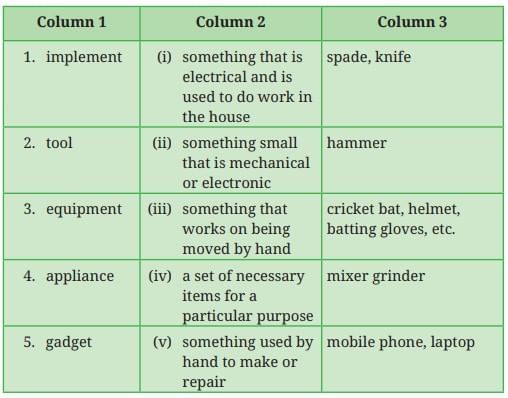 Answer:
| Column 1 | Column 2 | Column 3 |
|---|---|---|
| 1. implement | (iii) something that works on being moved by hand | Spade, knife, hoe, scissors, screwdriver |
| 2. tool | (v) something used by hand to make or repair | hammer, screwdriver, wrench |
| 3. equipment | (iv) a set of necessary items for a particular purpose | Cricket bat, helmet, gloves, lab equipment, gym machines |
| 4. appliance | (i) something that is electrical and is used to do work in the house | Mixer grinder, refrigerator, washing machine, microwave, toaster |
| 5. gadget | (ii) something small that is mechanical or electronic | Mobile phone, laptop, smartwatch, calculator, drone |
III. Complete the table by making new words in Column 1 using the hints given new in Column 2. Replace the first letter of the given word to create words. One example has been done for you.
1.
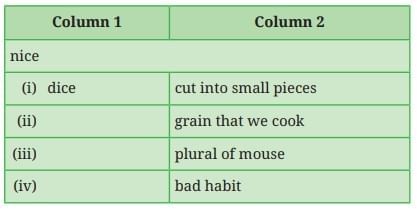 Ans:
Ans:
| Column 1 (Type of Word) | Column 2 (Hint) | Column 3 (Examples or Related Terms) |
|---|---|---|
| 1. Nice | Pleasant feeling | Kindness, smile, warmth |
| 2. Dice | (i) Dice cut into small pieces | Cubes, bits, chopped vegetables |
| 3. Rice | (ii) Grain that we cook | Porridge, sushi, pilaf |
| 4. Mice | (iii) Plural of mouse | Rodents, pests, small animals |
| 5. Vice | (iv) Bad habit | Smoking, laziness, gambling |
2. 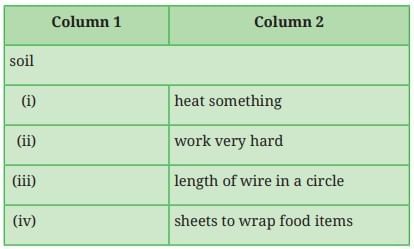
Ans:
| Column 1 (Type of Word) | Column 2 (Hint) | Column 3 (Examples or Related Terms) |
|---|---|---|
| 1. Soil | Earth or ground material | Dirt, mud, clay |
| 2. Boil | (i) Heat something | Water, soup, vegetables |
| 3. Toil | (ii) Work very hard | Labor, effort, farming |
| 4. Coil | (iii) Length of wire in a circle | Spring, rope loop, cable |
| 5. Foil | (iv) Sheets to wrap food items | Aluminum wrap, plastic cover |
I. The speaker of the poem might have felt sorry for stepping on Mrs. Jones' flower. When we make a mistake, we must express regret and apologise for our actions.
1. When we apologise to a friend or a family member, we use informal language. Take turns to apologise for the following situations and respond to the apology.
(i) You have eaten your brother's share of sweets.
(ii) You have broken your sister's flower craft.
(iii) You accidentally spilled ink on your mother's important documents.
(iv) You forgot to bring your friend's notebook to the school after borrowing it.
You may use the following phrases given below.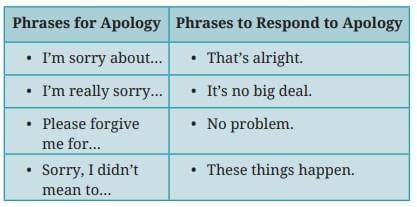
Ans: The speaker of the poem might have felt sorry for stepping on Mrs. Jones's flower, and we should express regret when we make mistakes. Below are apologies and responses for the given situations using informal language.
(i) You have eaten your brother's share of sweets.
- Apology: "I'm really sorry about eating your sweets, bro. I didn’t mean to!"
- Response: "That’s alright, but save some for me next time!"
(ii) You have broken your sister's flower craft.
- Apology: "Sorry, I didn’t mean to break your flower craft, sis. Please forgive me!"
- Response: "No problem, but be careful next time. These things happen."
(iii) You accidentally spilled ink on your mother's important documents.
- Apology: "I’m sorry about spilling ink on your documents, Mom. It was an accident!"
- Response: "It’s no big deal, but please be more careful in the future."
(iv) You forgot to bring your friend's notebook to school after borrowing it.
- Apology: "I’m really sorry for forgetting your notebook, buddy. Please forgive me!"
- Response: "That’s alright, just bring it tomorrow. No problem!"
2. When we apologise to someone in authority like a Principal or a teacher in a formal setting, we use formal language. Work in pairs and take turns to apologise for the following situations and respond to the apology.
(i) You did not bring an assignment that was due for submission.
(ii) You the Principal. were late to school for the past three days and had to meet
(iii) You did not submit your project work and were asked to explain. You may use the phrases given below.
You may use the phrases given below.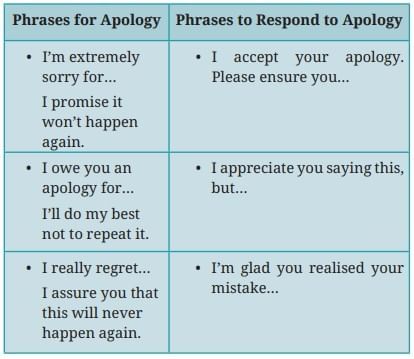
Ans: When apologizing to a Principal or teacher, we use formal language. Below are apologies and responses for the given situations, worked in pairs, using formal phrases.
(i) You did not bring an assignment that was due for submission.
- Apology: "I’m extremely sorry for not bringing my assignment, Sir/Ma’am. I promise it won’t happen again."
- Response: "I accept your apology. Please ensure you submit it tomorrow."
(ii) You were late to school for the past three days and had to meet the Principal.
- Apology: "I owe you an apology for being late to school for the past three days, Principal. I’ll do my best not to repeat it."
- Response: "I appreciate you saying this, but please be on time from now on."
(iii) You did not submit your project work and were asked to explain.
- Apology: "I really regret not submitting my project work, Sir/Ma’am. I assure you that this will never happen again."
- Response: "I’m glad you realised your mistake. Please submit it by the end of this week."
You are a member of the Nature Club of your school. Draft a notice informing the students of Grades 6-8 about the inauguration of the Herb Garden. 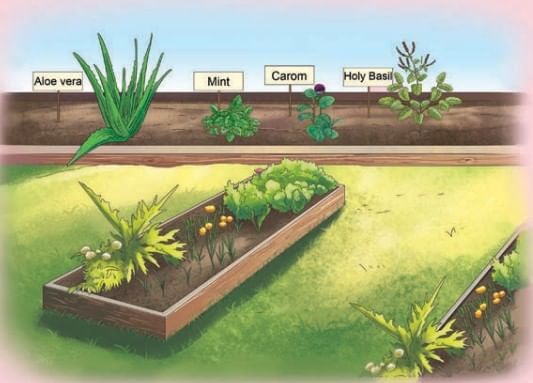
Points to remember:
- Mention the purpose of writing, date, time, venue, and any other relevant information-whom to contact, when, and where.
- Use formal language in the third person form.
- Write the notice in a box.
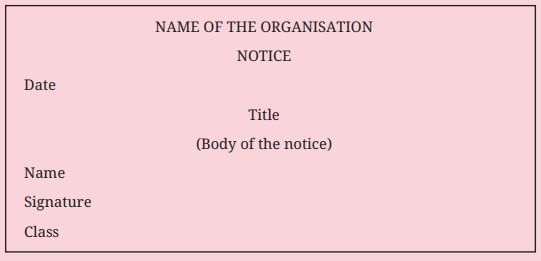
Ans:
DELHI PUBLIC SCHOOL, Delhi
NOTICE
Nature Club
Inauguration of the Herb Garden!
The Nature Club is pleased to announce the inauguration of the new Herb Garden, aimed at promoting awareness about medicinal plants and sustainable gardening among students. All students of Grades 6-8 are invited to attend the event. The details are as follows:
- Date: 25th July 2025
- Time: 10:00 AM – 11:30 AM
- Venue: School Courtyard (Near Science Block)
Students are encouraged to participate and learn about the benefits of herbs. For further information, please contact the Club Coordinator, Ms. Sharma, at the school office between 2:00 PM and 3:00 PM on weekdays.
Let’s grow green together!
Name: Aryan Patel
Signature:
Class: 8B
I. Amrit Udyan is a garden spread over an expanse of 15 acres around Rashtrapati Bhavan in New Delhi. It has multiple attractions that include a specially curated garden for children called Bal Vatika, a treehouse, nature's classroom, etc. It also has the Bonsai, Herbal-I, Herbal-II, Tactile Garden, Arogya Vanam, and Circular Gardens with a diverse variety of flora and fauna.
Now, find out about popular gardens in your region and share with your classmates and teacher.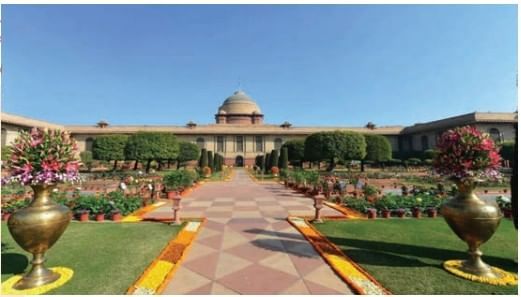
Ans: Example (If your region is Mumbai):
- Garden Name: Sanjay Gandhi National Park (Borivali)
- Location: Borivali East, Mumbai
- Area: ~104 sq. km
- Attractions: Lion & Tiger Safari, Kanheri Caves, Nature Trails, Butterfly Park
- Unique Features: One of the largest national parks within a city, rich biodiversity.
II. A herbarium is a collection of plant samples preserved for long-term study, usually in the form of dried and pressed plants mounted on paper. Now, collect some fallen flowers and leaves from your neighbourhood. Place them in folds of a newspaper carefully and put a pile of books on them. After one week, take them out and use them to make a card, wall hanging or any other artwork. A sample has been given for your reference.
III Read and enjoy the poem.
A Sea of Foliage
A sea of foliage girds our garden round,
But not a sea of dull unvaried green,
Sharp contrasts of all colours here are seen;
The light-green graceful tamarinds abound
Amid the mango clumps of green profound,
And palms arise, like pillars gray, between;
And o'er the quiet pools the seemuls lean,
Red-red, and startling like a trumpet's sound.
But nothing can be lovelier than the ranges
Of bamboos to the eastward, when the moon
Looks through their gaps, and the white lotus changes
Into a cup of silver. One might swoon
Drunken with beauty then, or gaze and gaze
On a primeval Eden, in amaze.
- TORU DUTT
Subscribe to:
Posts (Atom)